*virtualexhibitions_ranking_title*

*apsaugos_kodas*
*alt_phpcaptcha_generated_image*
Loading
*virtualexhibitions_rank_submit_message*

{{msg}}

100 years of diplomatic relations between Lithuania and Spain

100 years of diplomatic relations between Lithuania and Spain

To mark the centenary of diplomatic relations between the Republic of Lithuania and the Kingdom of Spain in 2022, an exhibition entitled “100 Years of Diplomatic Relations between Lithuania and Spain” has been organised to present the relations between Lithuania and Spain, which have linked the two countries since the 15th century.
The first meeting between Lithuanians and Spaniards known to historians took place in 1412, when an envoy of the King of Castile visited the residence of Vytautas the Great in Kaunas. In the 16th century, when the struggle between Catholics and Protestants broke out, Spanish Jesuits arrived in Lithuania, leaving their mark on the history of Vilnius University and Lithuanian education, and occupying high positions in the courts of the Grand Dukes of Lithuania. In the 17th century, Władysław IV Vasa, the heir to the throne of the Grand Duchy of Lithuania, traveled around Europe, visiting Spanish domains, meeting with Spanish governors and envoys, and acquiring knowledge of culture, warfare and engineering. In the 18th century, rulers of the Polish–Lithuanian Commonwealth originating from the House of Wettin, a Saxon dynasty, united by marriage with the House of Bourbon that ruled Spain. There is also knowledge of Lithuanians who fought in Spain during the Napoleonic Wars.
The now customary interstate relations between Lithuania and Spain were established after the First World War. Spain officially recognised Lithuania in 1922. The Republic of Lithuania was represented in Spain during the inter-war period by Oscar Milosz and Petras Klimas, both residing in Paris.
In July 1940, when the Soviet Union occupied Lithuania, Vincas Krėvė-Mickevičius, the then Minister of Foreign Affairs of the puppet government, ordered all Lithuanian diplomats to come to Kaunas urgently “for official business”. The diplomats realised the deception and refused to return to Lithuania. This preserved the Lithuanian diplomatic service, the only official institution of independent Lithuania that remained insubordinate to the Soviet system, which continued to represent Lithuania abroad and testified to the continuity of Lithuanian statehood during the long years of occupation. In 1955, thanks to the efforts of the Supreme Committee for the Liberation of Lithuania (VLIK), with the permission of Spain, Lithuanian radio broadcasts to Lithuania were launched from the territory of this country.
In 1990, after the restoration of Lithuania’s independence, Spain soon recognised it. In 1992, the first representative of the restored Republic of Lithuania to Spain was appointed, and in 1994, an embassy was opened in Madrid.
Lithuania joined the EU and NATO in 2004, and closer economic, political, cultural and military cooperation between Lithuania and Spain began.
The archival documents presented at the exhibition will provide a rich illustration of diplomatic relations between Lithuania and Spain and reveal the experience of cooperation between the two countries over the centuries.
The organiser of the exhibition is the Office of the Chief Archivist of Lithuania.
The patron of the exhibition – Member of the Seimas, the Head of Group for Inter-Parliamentary Relations with the Kingdom of Spain, Gintarė Skaistė.
Partners of the exhibition: the Office of the President of the Republic of Lithuania, the Office of the Seimas of the Republic of Lithuania, Lithuanian Central State Archives, Lithuanian State Historical Archives, the National Archives of Spain, the National Museum – Palace of the Grand Dukes of Lithuania, the Lithuanian National Museum of Art, Vilnius University Library.

100 years of diplomatic relations between Lithuania and Spain

Ties that have linked two distant countries for centuries

In the 15th century, the Grand Duchy of Lithuania and Spain (then the kingdoms of Castile and Aragon) were extremely distant countries, both geographically and culturally. However, no matter how distant, the first Spanish visit to Lithuania known to historians took place in Kaunas and dates back to the time of Vytautas the Great, when in 1412, the ruler of Castile, Fernando I (1380-1416), commissioned the knight Alfonso Mudarra, during his pilgrimage from Valladolid to Jerusalem (via Europe), to visit the courts of influential European monarchs, to make long-distance acquaintances, and thus to reinforce the authority of Fernando I as ruler. In 1412, an envoy of the King of Castile visited Lithuanian Grand Duke Vytautas the Great (1350-1430) in Kaunas. It is not known what the envoy did after this trip, and the visit itself was not of great political significance at the time.

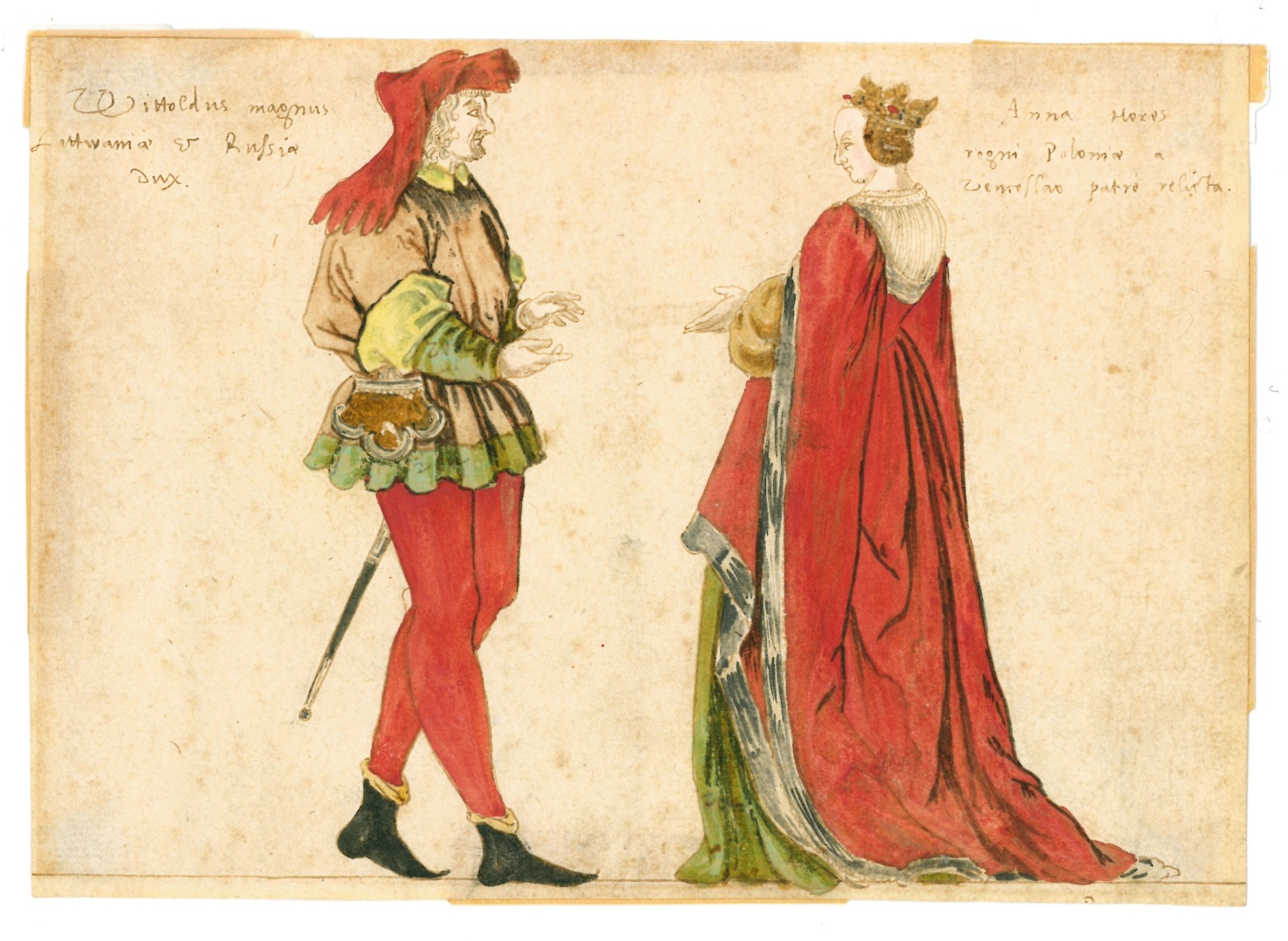
Lithuanian Grand Duke Vytautas the Great and Anna, Grand Duchess of Lithuania Unknown German artist, 16th century. This is the earliest known drawing of the ruler. © National Museum – Palace of the Grand Dukes of Lithuania, VR-827.

100 years of diplomatic relations between Lithuania and Spain

The most prominent Spaniards in Lithuania in the 16th and 17th centuries

Pedro Ruiz de Moros (1505-1571) Born in Alcañiz in the Kingdom of Aragon. After learning Latin and Greek in his hometown, he entered the University of Lleida in 1528, where he graduated in law, and in 1540 he obtained a double doctorate in Roman and canon law at the University of Bologna. The constant wars between Spain and France made him reluctant to return to his homeland.

In 1542, in Bologna, with the intervention of Queen Bona Sforza (1494-1557), the lawyer was appointed to the University of Cracow, and in 1549 Pedro Ruiz de Moros became the legal adviser to King Sigismund Augustus, moving with the court to Vilnius.

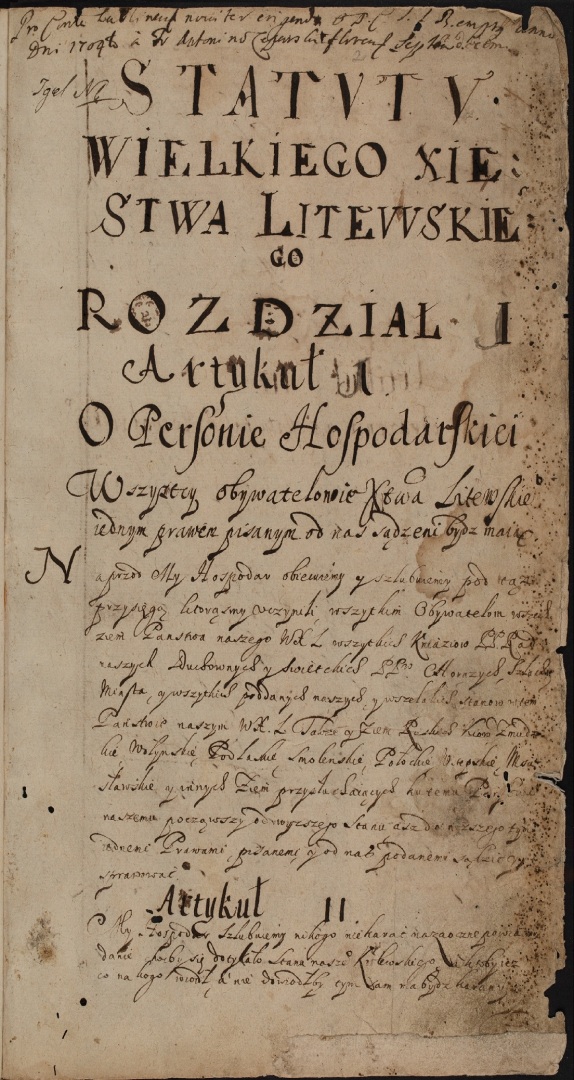
From 1551 to 1571, he was the head of the St. John Church school. He taught law and classical languages and was one of the drafters of the most important legal document of the Grand Duchy of Lithuania, the Second Statute of Lithuania (1566).

Second Statute of Lithuania, manuscript, transcript in Polish Bielsk, 1564 (orig.), turn of the 17th-18th centuries (trans.). Vilnius University Library.


100 years of diplomatic relations between Lithuania and Spain

The most prominent Spaniards in Lithuania in the 16th and 17th centuries

Garcia Alabiano (1549–1624) Originally from Tarragona, he studied theology in Zaragoza, Valencia, Barcelona and Rome. After arriving in Lithuania, from 1578 he headed the Department of Scholastic Theology at Vilnius College, in 1583 he became an advisor to the Rector of the University, and in 1584-1592 he was the Rector of the University, and was responsible for the development of Vilnius University.

He was on good terms with the rulers of the Polish–Lithuanian Commonwealth, Stephen Báthory and Sigismund III Vasa, as well as Cardinal Jerzy Radziwiłł. Together with another Spanish monk working in Vilnius, he published collections of theological theses.

Garcia Alabiano left Lithuania in 1592 and returned to Spain in 1600, where he was rector of a Jesuit school in Zaragoza.

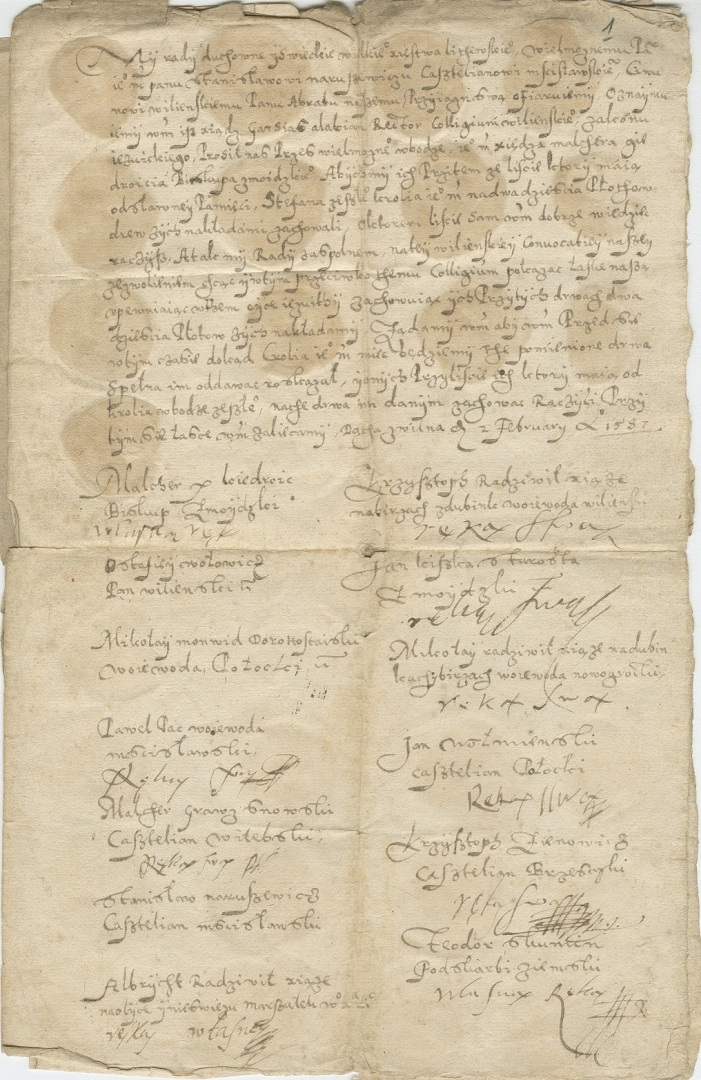
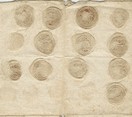
Permission from the Lithuanian Council of Lords to provide Vilnius Jesuit School with firewood for heating The Lithuanian Council of Lords of the Grand Duchy of Lithuania, in response to the request of the Rector of Vilnius Jesuit School, father Garcia Alabiano, grants permission to the Castellan of Mstislav and the Tiun of Vilnius, Stanisław Naruszewicz, to provide the Jesuit School with 20 rafts for firewood. The document is authenticated by the signatures and seals of 13 members of the Council of Lords. Vilnius, 2 February 1587. In Polish. Lithuanian State Historical Archives.

100 years of diplomatic relations between Lithuania and Spain

The most prominent Spaniards in Lithuania in the 16th and 17th centuries

Miguel Ortiz (1560–1638) Originally from Victoria, in the province of Córdoba. He joined the Jesuit Order after his theological studies and from 1595 began to teach theology and philosophy at Vilnius University, and from 1605 to 1609 he held the position of rector of Vilnius University. From 1622 to 1627 he was the provincial superior of Lithuania and completed the foundation of the college in Grodno, received the consent to open the faculties of Law and Medicine at Vilnius University, and was commissioned with the construction of a library and the management of the archives. As Miguel Ortiz was close to the House of Radziwiłł, he was buried in Nesvizh after his death in 1638.

Benito de Sojo (1586-1658) Originally from Baeza in Andalusia. After completing a course in rhetoric in Montilla in 1602, he studied philosophy in Seville from 1605 to 1608 and theology in Granada from 1608 to 1612. He worked in Spanish Jesuit schools, teaching rhetoric, philosophy and theology. In 1624 he came to Vilnius and taught scientific theology and canon law at Vilnius University until 1631, publishing the first law textbook in Lithuania, and serving as rector from 1643 to 1646. In 1655, when the invasion of the Polish–Lithuanian Commonwealth, began in 1655 by Sweden and Moscow, Benito de Sojo left Lithuania, and three years later died in Antwerp.

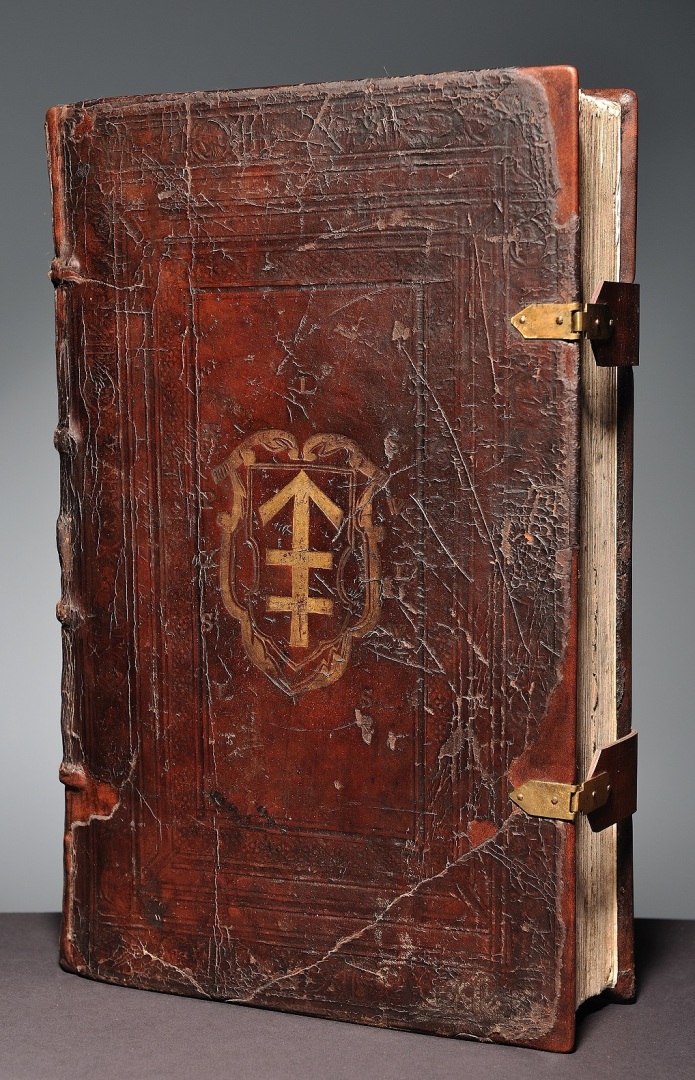
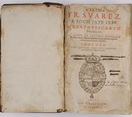
Francisco Suárez’s (1548-1617) book Metaphysicarvm Disputationum, in qvibvs et vniversa natvralis Theologia ordinatè traditur, et quæstiones ad omnes duodecim Aristotelis libros pertinentes, accuratè disputantur. Tomi dvo..., Geneva, 1636. © National Museum – Palace of the Grand Dukes of Lithuania, VR-496. Photographer Mindaugas Kaminskas.

100 years of diplomatic relations between Lithuania and Spain

The most prominent Spaniards in Lithuania in the 16th and 17th centuries

Alberto Perez (about 1620–1689) Born in Antequera in the Andalusian region, he was a graduate of the University of Salamanca and held a doctorate in philosophy and medicine. From Spain, he moved to the city of Torun where he practised medicine.

His success led him to become a physician to the future Chancellor of the Grand Duchy of Lithuania, the then commander of Trakai, Marcjan Aleksander Ogiński (1632- 1690), and to join the ranks of his courtiers and servants.

In 1680, he arrived in Vilnius and joined the city’s community, the same year he married Gertrude Fahrn, the widow of the wealthy wine merchant Paulus Urbanavičius (?-1678). Alberto Perez bought a brick house in the centre of Vilnius, on Stiklių Street, which was already considered prestigious at the time, from his father-in-law, the wine merchant M. Fahrn, and settled there, where he worked as a doctor and as a councillor of the city of Vilnius.

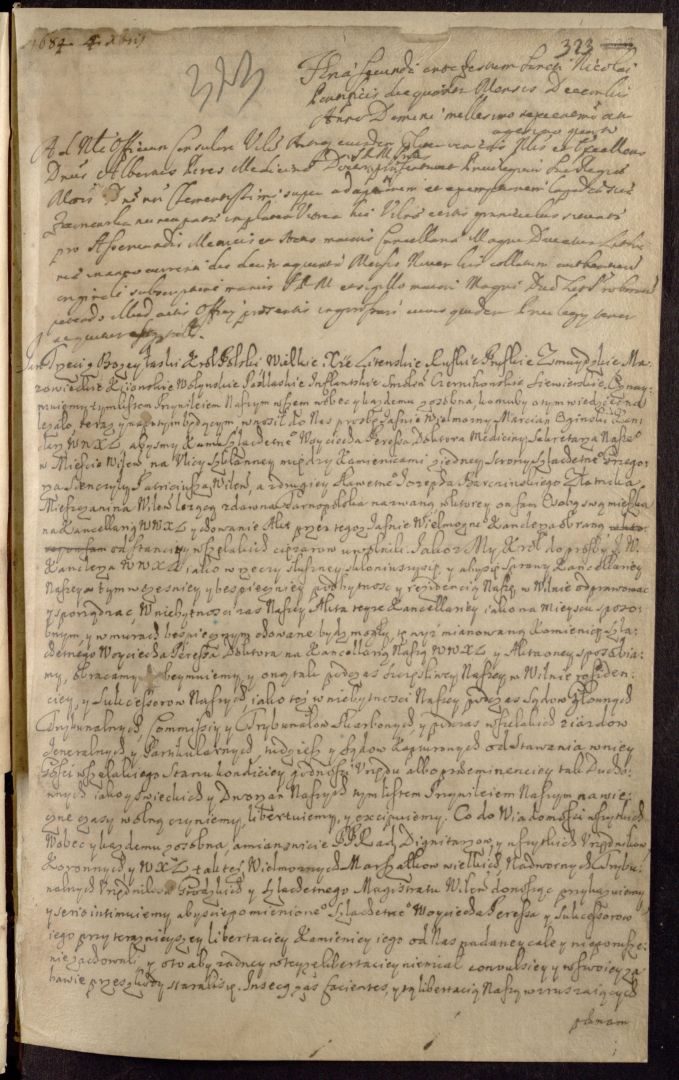
It was probably thanks to his close relationship with the Chancellor that in 1684 the King of Poland and Grand Duke of Lithuania, John III Sobieski, granted the visiting doctor the privilege of storing a part of the Lithuanian Metrica in his house on Stiklių Street.

This decision was partly forced, as the Lower Castle was simply running out of space for the archive of the Chancery of the Grand Duchy of Lithuania. In total, only six 17th-century rulers’ privileges are known to be related to the storage of the Lithuanian Metrica in the most prestigious places in the city – the Town Hall Square, Didžioji Street and Stiklių Street.

Copy of the privilege of John III Sobieski, King of Poland and Grand Duke of Lithuania, regarding the use of Alberto Perez’s brick house on Stiklių Street for the storage of the Lithuanian Metrica From the record book of Vilnius City Council 1684-1687. Lviv, 15 November 1684 (endorsed on 4 December 1684). In Latin and Polish. Lithuanian State Historical Archives.

100 years of diplomatic relations between Lithuania and Spain

Władysław Vasa’s tour of the Spanish territories (1624-1625)

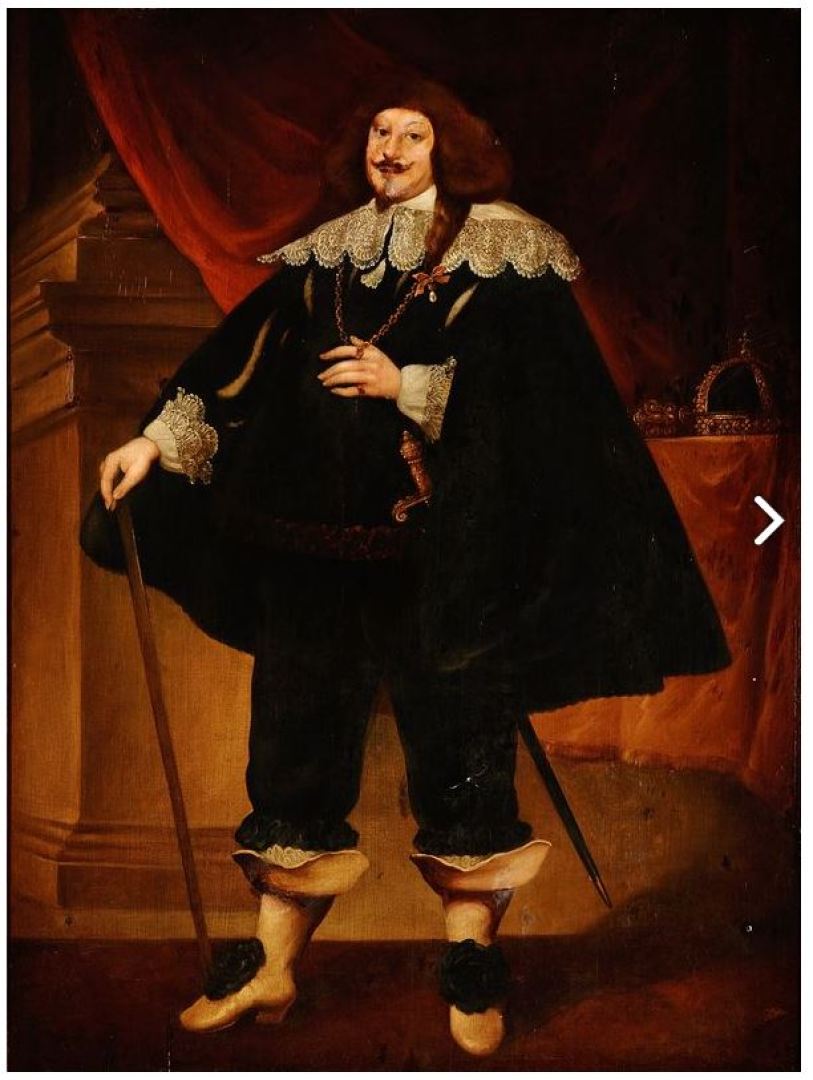
During his journey across Europe between 1624 and 1625, Prince Władysław Vasa visited the Spanish possessions of the southern Netherlands, Milan and the Kingdom of Naples, and met with high Spanish officials.

Władysław Vasa also had an important political objective during his journey, namely to form an alliance between the Polish–Lithuanian Commonwealth and Spain in the war against Sweden. Every effort was made to maintain the strict anonymity of the delegation, which was repeatedly emphasised in the reports on the journey.

The solemn reception prepared for Prince Władysław Vasa by Isabella Clara Eugenia, Governor of the Spanish Netherlands, and the visits to the Spanish political elite in Brussels were described in considerable detail in the old documents. In Antwerp, the Prince visited the studios of many painters and the studio of Rubens.

An important element of his stay in the Netherlands was a tour of the fortifications and warfare. On two occasions in 1624, Prince Władysław Vasa observed the Spanish army besieging Breda. First, in early September, when he travelled to Brussels, and later that month he visited the military camp and was received by the commander-in-chief of the Spanish army, General Ambrogio Spinola (1569-1630). There he saw the Spanish armaments and artillery positions, fortifications, infantry exercises and live artillery battles (a tour of the Spanish positions during the battles).

The next visit of Władysław Vasa took place after the arrival of the Lithuanian and Polish delegation in Milan (15 September 1624), at the Visconti Castle in Milan, at the invitation of Governor Gomez Suarez de Figueroa (1587- 1634). The castle was used as the headquarters of the Spanish garrison in the city. The castle was shown to the visiting delegation by the commander of the fortress himself.

Władysław Vasa was also treated with exceptional respect during his visit to Naples and its surroundings. On the very first day of his stay in Naples (8 January 1625), he was honoured with a visit from the Duke of Alba, the Viceroy of Naples, Antonio Alvarez de Toledo. His stay in the capital of the Kingdom of Naples included various ceremonies and visits to churches, as well as a visit to the city of Pozzuoli, where he saw the city’s old buildings and monuments.

In 1636, Jean de Croÿ, count of Solre (1588-1638), envoy of King Philip IV of Spain, attended the premiere of the first opera in Lithuania called “Abduction of Helena” at Vilnius Lower Castle.

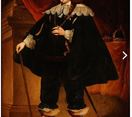
Portrait of Władysław Vasa Unknown author after Frans Luycx (1604-1668), c.1800. © National Museum – Palace of the Grand Dukes of Lithuania, VR-1025. Photographer Vytautas Abramauskas.
100 years of diplomatic relations between Lithuania and Spain

Władysław Vasa’s tour of the Spanish territories (1624-1625)

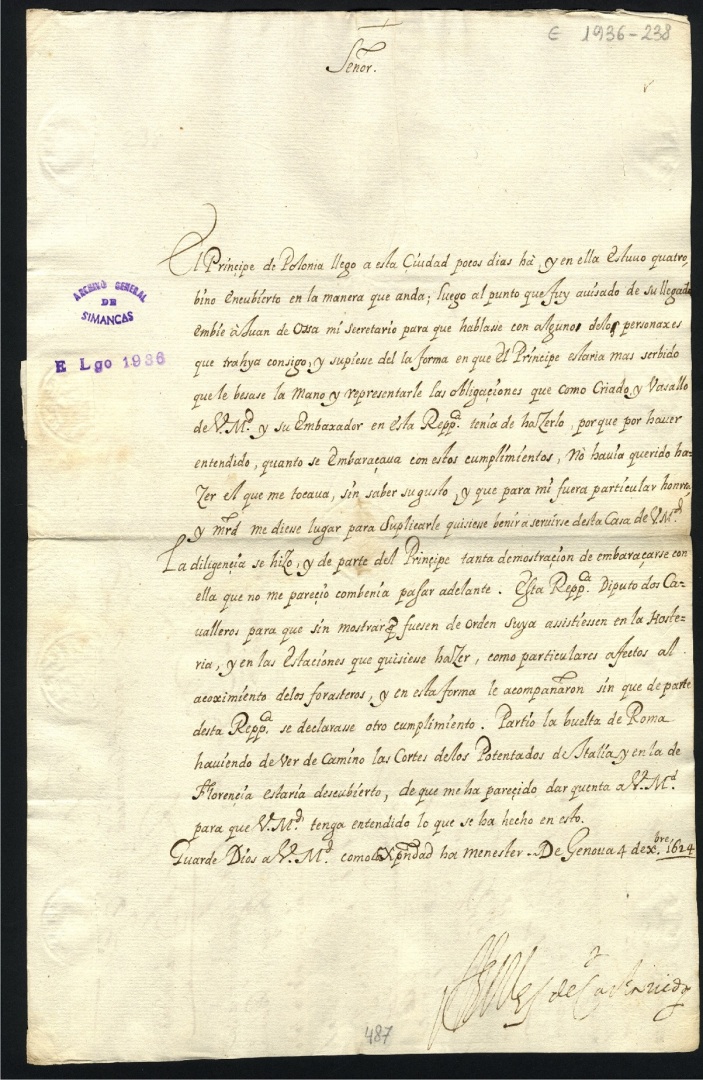
Letter from Sancho de Monroy y Zúñiga, marquis of Castañeda, Spanish ambassador in Genoa, to Philip IV, King of Spain, on the incognito arrival in Genoa of Vladislaus IV Vasa, Prince of Poland. 1624-12-04. Genoa. 2 sheets, paper, 30 × 20,3 cm spa; Latn. Spanish ‘bastarda’ script. Spain. Ministry of Culture and Sports. General Archive of Simancas. AGS,EST,LEG,1936,238.

100 years of diplomatic relations between Lithuania and Spain

Dynastic link

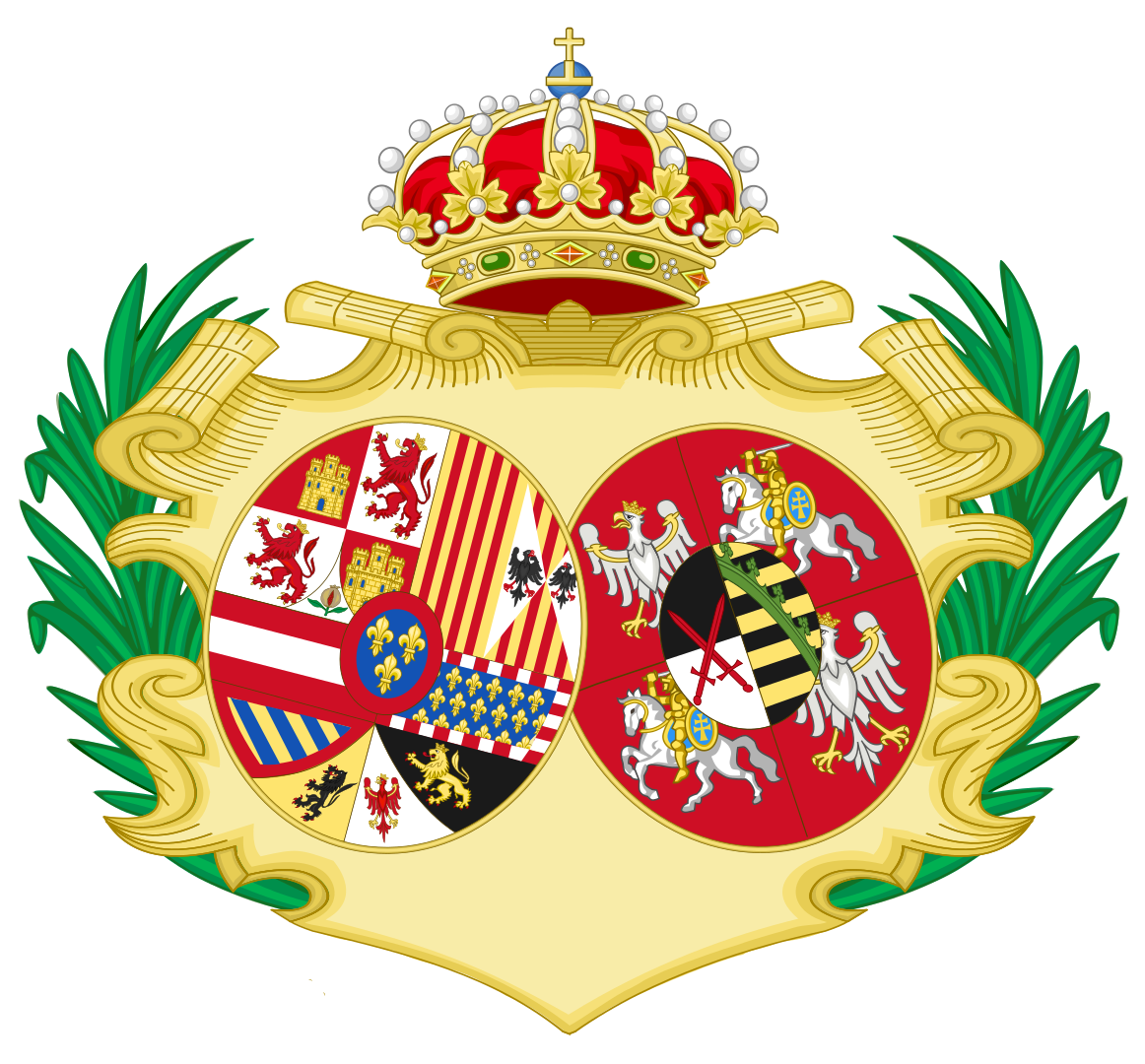
In the 18th century, the Polish–Lithuanian Commonwealth and the Spanish Empire were linked by a dynastic link. In 1738, Princess Maria Amalia (1724-1760), daughter of Augustus III, ruler of the Polish–Lithuanian Commonwealth and Saxony, married Charles III (1716-1788), King of Spain, Naples and Sicily. Charles III and Maria Amalia are the ancestors of the current King of Spain, Felipe VI.

The final partition of the Polish–Lithuanian Commonwealth in 1795 between Prussia, Austria-Hungary and Russia led to the disintegration of its diplomatic structures and the dispersal of refugees throughout Europe and the world. At the same time, some Lithuanians who had served in Napoleon’s army were fighting in Spain. Some were captured by the British there or volunteered to serve in the British army. Paulius Šelenskis from the village of Garužėnai (Kaunas County) was enlisted in the de Watteville regiment under the control of Britain in 1811 in Cartagena, Spain. Antanas Ronaitis from Marijampolė and hundreds of other Lithuanians had already joined the regiment the year before.

Marriage coat of arms of Charles III and Maria Amalia of Saxony Author Heralder. https://commons.wikimedia.org

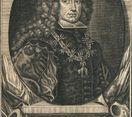
King of Spain Charles III (1716-1788) Unknown German author, 18th century engraving. Lithuanian National Museum of Art.

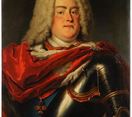
Portrait of Augustus III Louis de Silvestre (1675-1760) (?) environmental artist, 2nd half of the 18th century © National Museum – Palace of the Grand Dukes of Lithuania, VR-998. Photographer Mindaugas Kaminskas.

100 years of diplomatic relations between Lithuania and Spain

Efforts to restore the Lithuanian state

On February 12-14, 1916, Lithuanians living in Switzerland convened a conference in Bern, which was attended by Juozas Purickis, Antanas Viskanta, Vladas Daumantas, Antanas Steponaitis, Juozas Gabrys-Paršaitis, Justinas Tumėnas, and the representative of Lithuanians living in the United States of America, father Jonas Žilius-Jonila.

After the discussions, a resolution was adopted, which for the first time publicly called for the restoration of an independent Lithuanian state. The Swiss Lithuanians pledged to actively promote the idea of Lithuania’s independence in the foreign press and to draw the attention of the European public to the issue.

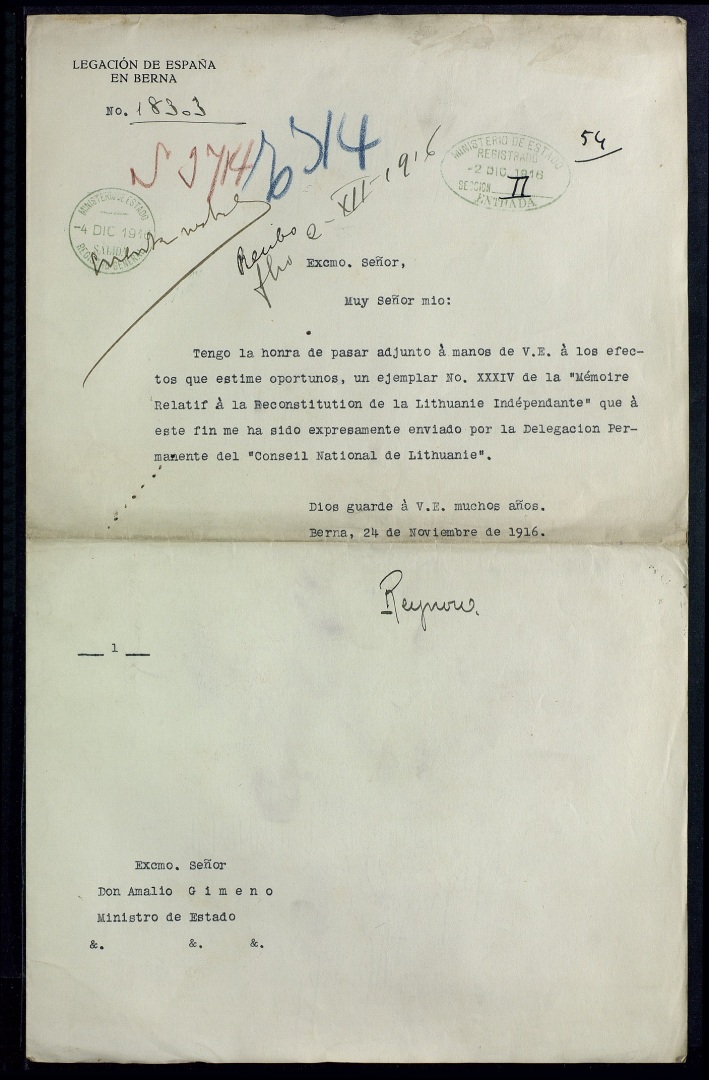
Letter from the Royal Spanish Embassy in Bern to the Spanish Government informing them of the resolution adopted at the 1916 Conference of the Council of the Lithuanian Nation held in Bern, which for the first time publicly demanded the restoration of an independent Lithuanian state Bern, Switzerland, 24 November 1916. National Historical Archive of Spain, digital copy from the Lithuanian Central State Archives.

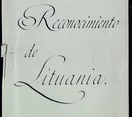
Title page of the file of diplomatic correspondence of the Kingdom of Spain concerning the recognition of Lithuanian independence Madrid, 1920. National Historical Archive of Spain, digital copy from the Lithuanian Central State Archives.

100 years of diplomatic relations between Lithuania and Spain

On 27 July 1922, Spain recognised the independence of Lithuania

Germany’s recognition of Lithuania’s independence on 23 March 1918 required an immediate search for recognition from other countries, but in the first years after the declaration of independence in 1918, Lithuania’s international recognition was slow.

Most major powers delayed and chose to recognise Lithuania de facto rather than de jure. It was only after the peace treaty with Soviext Russia was signed on 12 July 1920 that the process of recognising Lithuania’s independence accelerated.

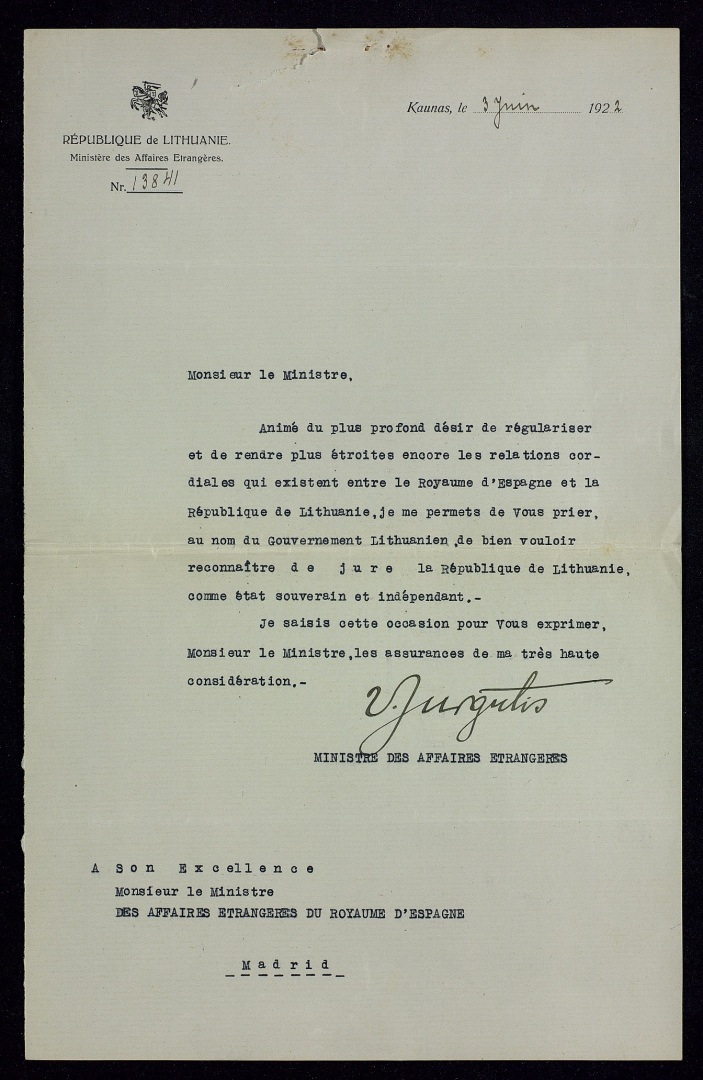
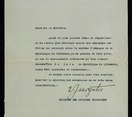
Request from the Minister of Foreign Affairs of the Republic of Lithuania, Vladas Jurgutis, to the Minister of Foreign Affairs of the Kingdom of Spain for de jure recognition of the State of Lithuania Kaunas, Lithuania, 3 June 1922. National Historical Archive of Spain, digital copy from the Lithuanian Central State Archives.

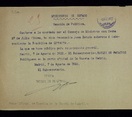
Press release from the Government of the Kingdom of Spain announcing that Spain recognised the Republic of Lithuania as an independent state on 27 July 1922 Madrid, 7 August 1922 National Historical Archive of Spain, digital copy from the Lithuanian Central State Archives.

100 years of diplomatic relations between Lithuania and Spain

On 27 July 1922, Spain recognised the independence of Lithuania

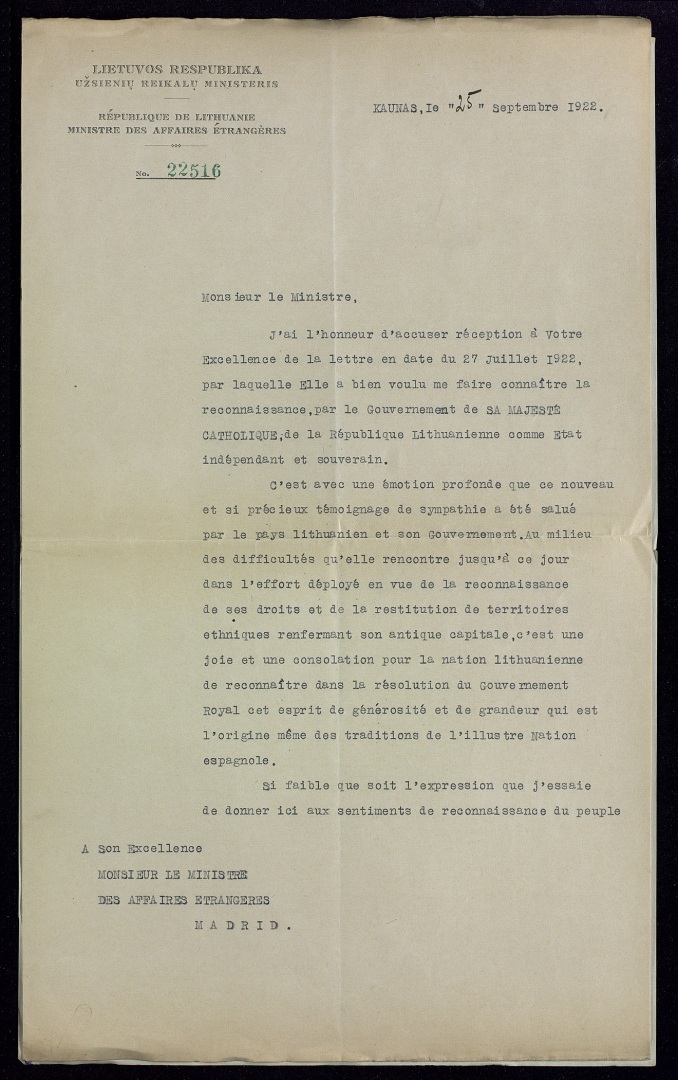
Letter from the Minister of Foreign Affairs of the Republic of Lithuania, Vladas Jurgutis, to the Minister of Foreign Affairs of the Kingdom of Spain, thanking for the de jure recognition of Lithuania Kaunas, 25 September 1922. National Historical Archive of Spain, digital copy from the Lithuanian Central State Archives.

100 years of diplomatic relations between Lithuania and Spain

1 December 1919 – the first Lithuanian diplomatic mission is established in Paris

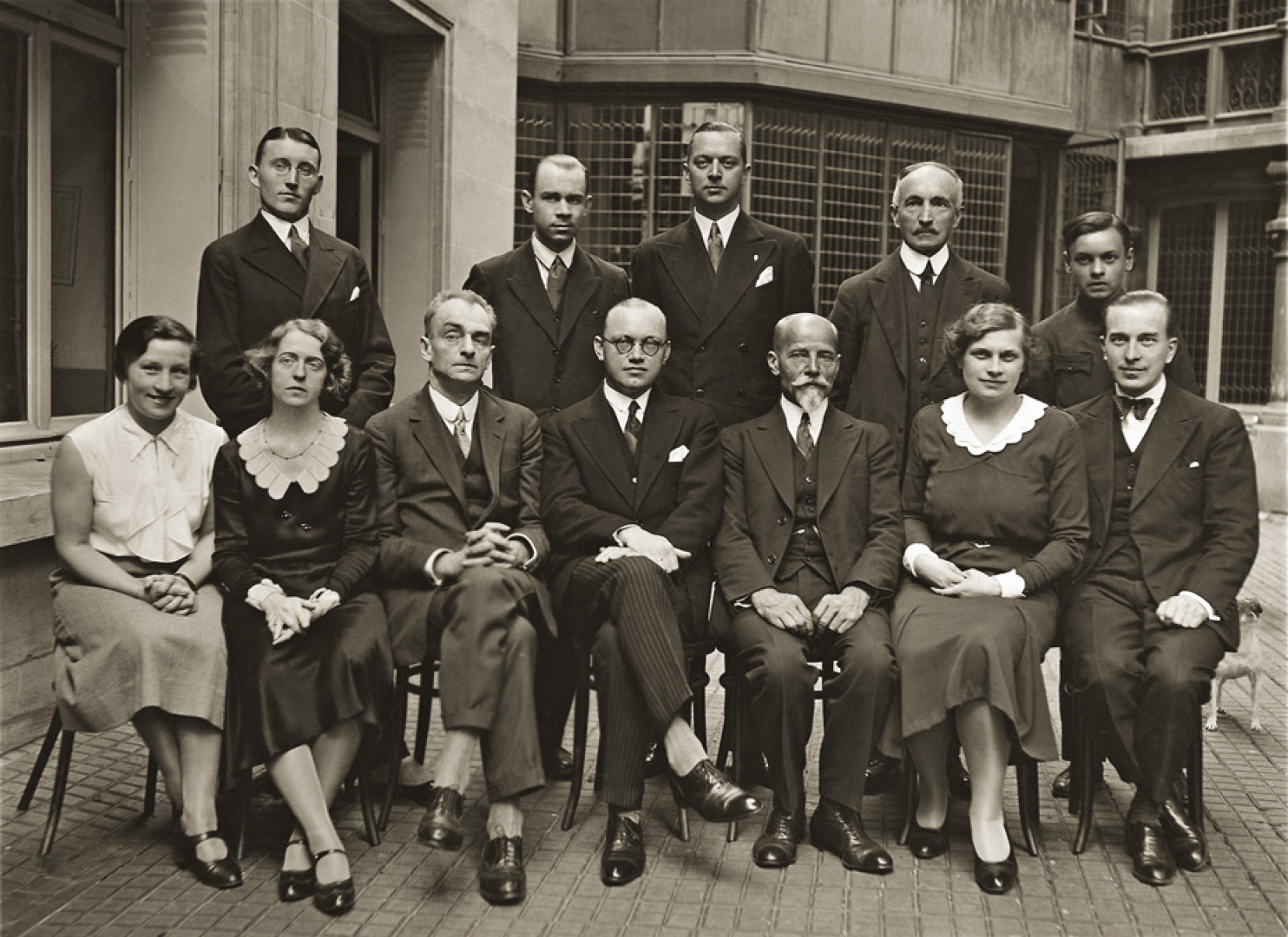
In 1918-1940, Lithuania did not have an independent diplomatic mission in the Kingdom of Spain. In 1919-1925, Lithuania was represented in Spain by the Lithuanian envoy to France, Oscar Milosz, and from 20 May 1925 until 1940 by the Envoy Extraordinary and Minister Plenipotentiary in France, Petras Klimas (1891- 1969), the Signatory of the Lithuanian Act of Independence of 16 February 1918.

When Lithuania was occupied by the Soviet Union in 1940, the Ministry of Foreign Affairs of the puppet “people’s government” suspended the operation of Lithuanian missions and consulates abroad, and a few days later foreign missions were ordered to leave Lithuania. Spain, like many other countries, officially declared that it did not recognise the occupation of Lithuania.

France surrendered in June 1940 after the German army occupied Paris, and the Lithuanian mission was forced to stop working. Diplomats moved to the south of France, and Lithuania’s diplomatic representation in both France and Spain also ceased.

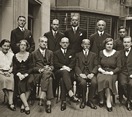
Employees of the Embassy of the Republic of Lithuania in Paris In the front row, third from the left – Oscar Milosz, the first representative of Lithuania in France, fourth – Petras Klimas, Envoy Extraordinary and Minister Plenipotentiary. Paris, France, 1932. Photographer not specified. Lithuanian Central State Archives.

Buenaventura Caro y del Arroyo, Envoy Extraordinary and Minister Plenipotentiary of the Kingdom of Spain to Lithuania, with Antonio Maria Agurre Gonzalo, Secretary of the Spanish Embassy in Czechoslovakia, after presenting letters of appointment to the President of the Republic of Lithuania, leaving the Presidential Palace Kaunas, Lithuania, 19 March 1932. Photographer not specified. Lithuanian Central State Archives.

100 years of diplomatic relations between Lithuania and Spain

Ceferino Palencia y Álvarez-Tubau

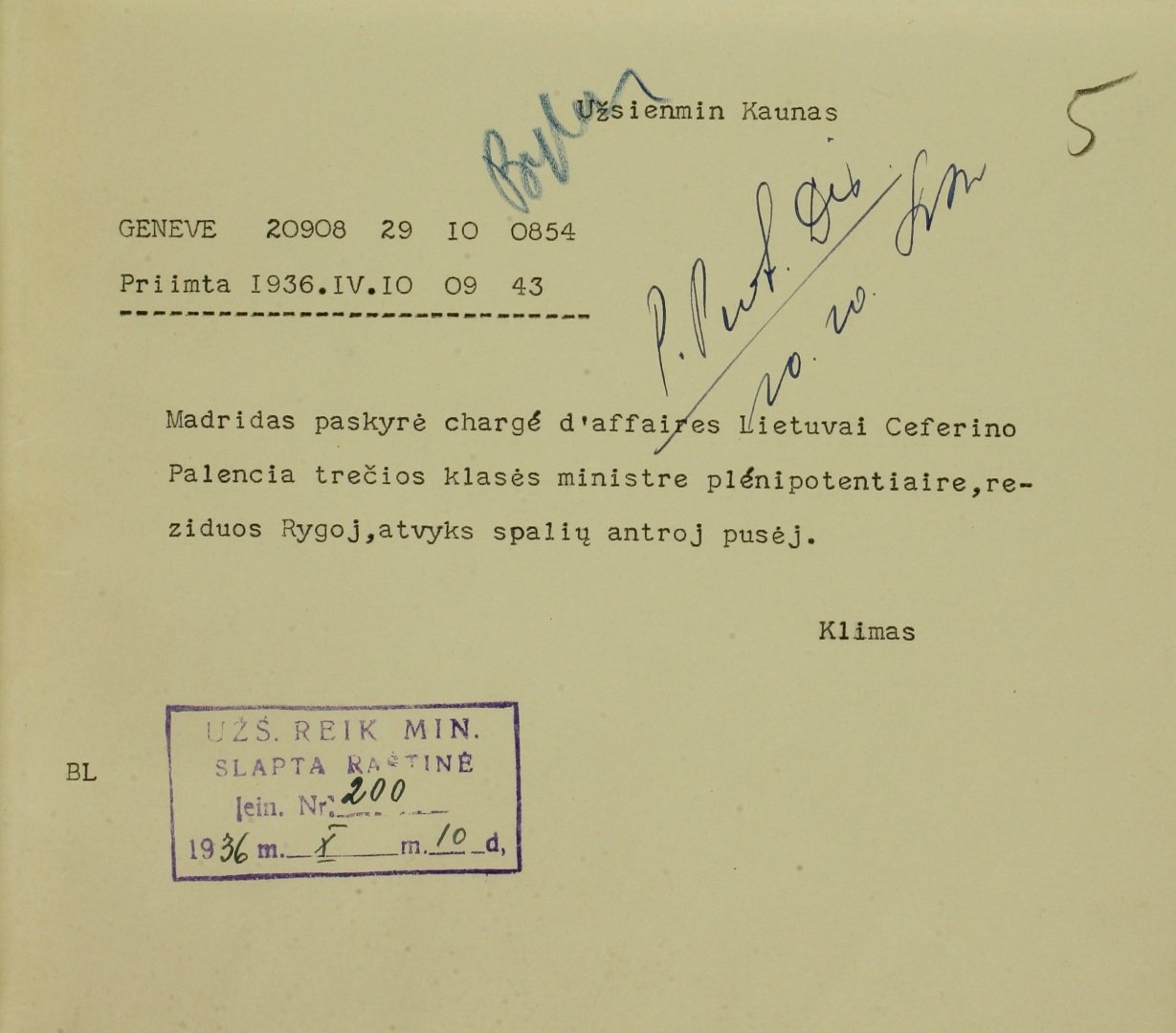
The only Spanish official to be honoured with a state award during the period of the First Republic of Lithuania was the Spanish art critic, writer and politician Ceferino Palencia y Álvarez-Tubau (1882-1963), who from 1936 served as Spain’s representative to Lithuania and Latvia, and was based in Riga.

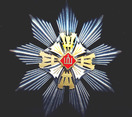
Ceferino Palencia y Álvarez-Tubau was awarded the 2nd Class Order of the Lithuanian Grand Duke Gediminas (Order No. 367a) on 16 February 1938.

Telegram from Petras Klimas, Envoy Extraordinary and Minister Plenipotentiary of the Republic of Lithuania to Spain, to the Ministry of Foreign Affairs of the Republic of Lithuania informing of the appointment of Mr Ceferino Palencia as the representative of the Kingdom of Spain in Lithuania and Latvia Geneva, Switzerland, 10 April 1936. Lithuanian Central State Archives.

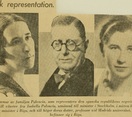
A clipping from the Swedish newspaper Dagens Nyheter with images of Ceferino Palencia, Spain’s representative in Lithuania and Latvia, his wife and daughter. 25 November 1936. Lithuanian Central State Archives.

Star of the 2nd Class Order of the Lithuanian Grand Duke Gediminas 2022, photographer Vilius Kavaliauskas.
100 years of diplomatic relations between Lithuania and Spain

Efforts by the Lithuanian emigrants to re-establish diplomatic representation of Lithuania

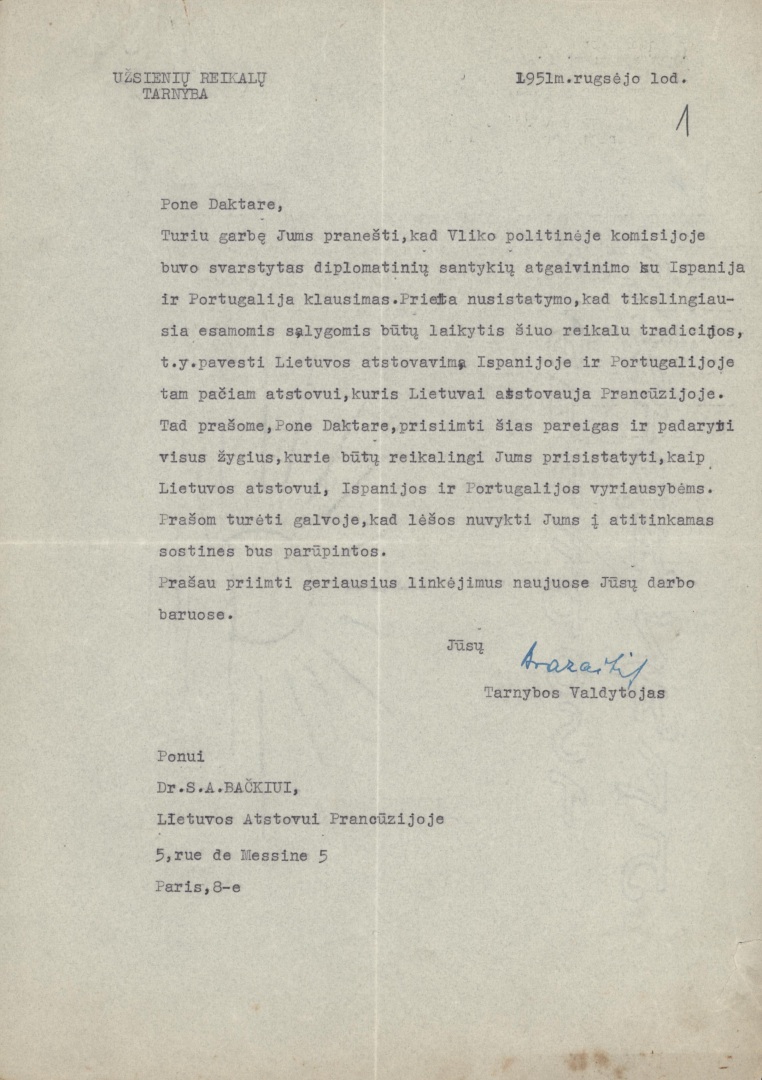
In the post-war period, the initiative of the Supreme Committee for the Liberation of Lithuania (VLIK) was to reestablish diplomatic relations with Spain and Portugal, with the diplomat Stasys Antanas Bačkis, who at the time represented Lithuania in France, as representative.

The Spanish government supported this endeavour, but wanted the representative to be a permanent resident in Madrid.

In 1952, Edvardas Turauskas (1896-1966), an emigrant diplomat, was offered to be Lithuania’s representative in Spain, but when he went to Madrid without the necessary documents from the VLIK leadership, the Spanish government postponed the consideration of Lithuania’s representation.

Thanks to the efforts of the VLIK and the Lithuanian bishops, the radio station Arganda in Madrid, via Radio Nacional de España, was able to broadcast daily to Soviet-occupied Lithuania for a decade (1955-1965).

Letter from Juozas Brazaitis, Head of the Foreign Service of VLIK, to Stasys Antanas Bačkis, Representative of Lithuania in France, concerning the re-establishment of diplomatic relations with Spain and Portugal Place not specified, 1 September 1951. Lithuanian Central State Archives.

Lithuanian and Estonian radio employees inspect the new Spanish radio transmitter in Arganda. From left to right – Lithuanian broadcast editor, Estonian broadcast editor Dr. Kuus, Lithuanian broadcast host and a Spanish engineer. Arganda, Spain, 1956. US Lithuanian magazine “Lietuvių dienos”, 1956, No. 3, page 6. Article “Alio, alio! Kalba Madridas”, by Alfonsas Taikunas.
100 years of diplomatic relations between Lithuania and Spain

Efforts by the Lithuanian emigrants to re-establish diplomatic representation of Lithuania

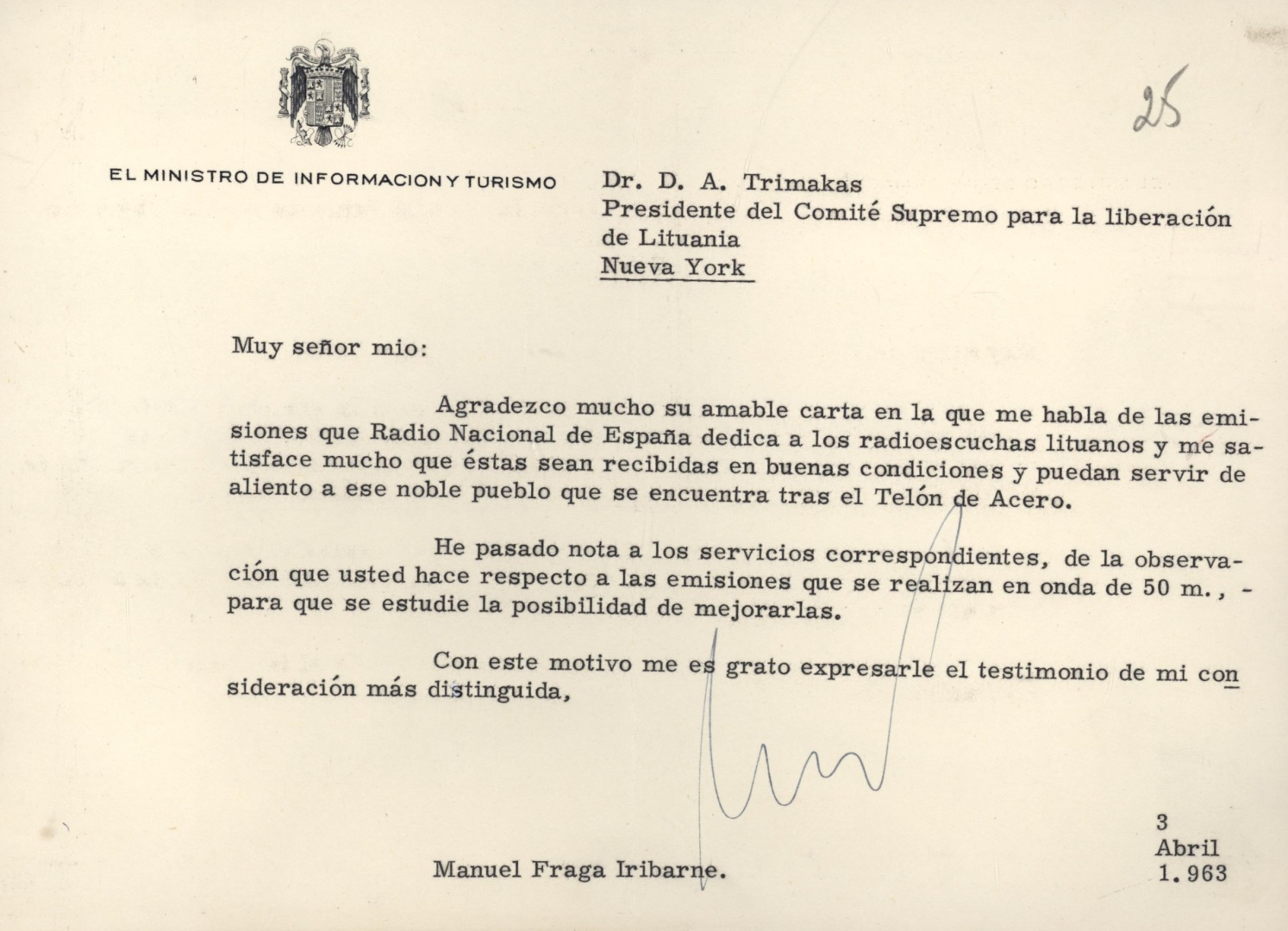
Letter from Manuel Fraga Iribarne, Minister of Information and Tourism of Spain, to Antanas Trimakas, Chairman of VLIK, regarding the improvement of Lithuanian broadcasts on Spanish radio Madrid, Spain, 3 April 1963. Lithuanian Central State Archives.
Letter from Justinas Lukošius to Juozas Audėnas, Vice-Chairman of VLIK, regarding the storage of recordings of VLIK radio broadcasts from the Arganda radio station in Germany in 1955-1965 Hüttenfeld, Germany, 1971. Lithuanian Central State Archives.
100 years of diplomatic relations between Lithuania and Spain

On 27 August 1991, Spain recognised the Republic of Lithuania, restored on 11 March 1990. Diplomatic relations between the two countries were re-established on 7 October the same year

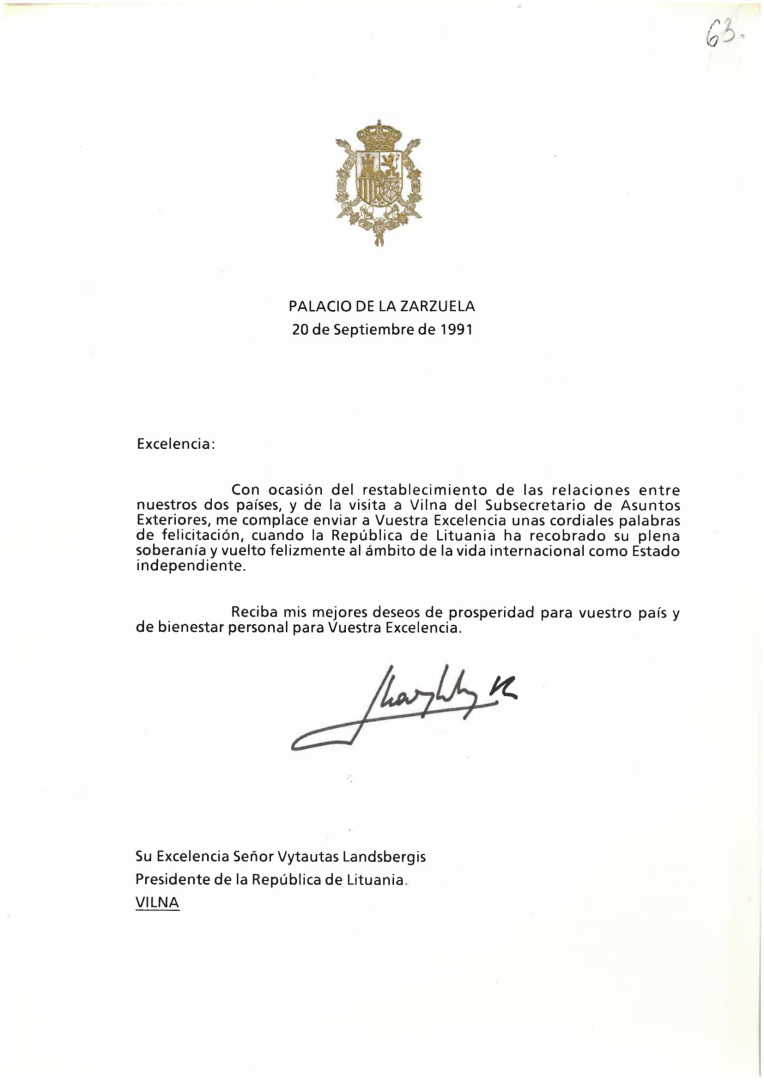
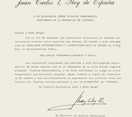
Congratulations of the King of Spain Juan Carlos I to the Chairman of the Supreme Council of the Republic of Lithuania Prof. Vytautas Landsbergis on the occasion of the restoration of the Independent Republic of Lithuania and diplomatic relations with Spain, on the occasion of the visit of the Secretary of the Ministry of Foreign Affairs of the Kingdom of Spain to Lithuania Madrid, Spain, 20 September 1991 Archive of Seimas of the Republic of Lithuania, f. 2, ap. 6, b. 509, l. 63.

Letter from King Juan Carlos I of Spain appointing Carlos Fernandez-Longoria y Pavia, residing in Denmark, as the first Ambassador Extraordinary and Plenipotentiary to Lithuania Madrid, Spain, 2 December 1991. Archive of Seimas of the Republic of Lithuania, f. 2, ap. 6, b. 304, l. 63.

100 years of diplomatic relations between Lithuania and Spain

On 27 August 1991, Spain recognised the Republic of Lithuania, restored on 11 March 1990. Diplomatic relations between the two countries were re-established on 7 October the same year

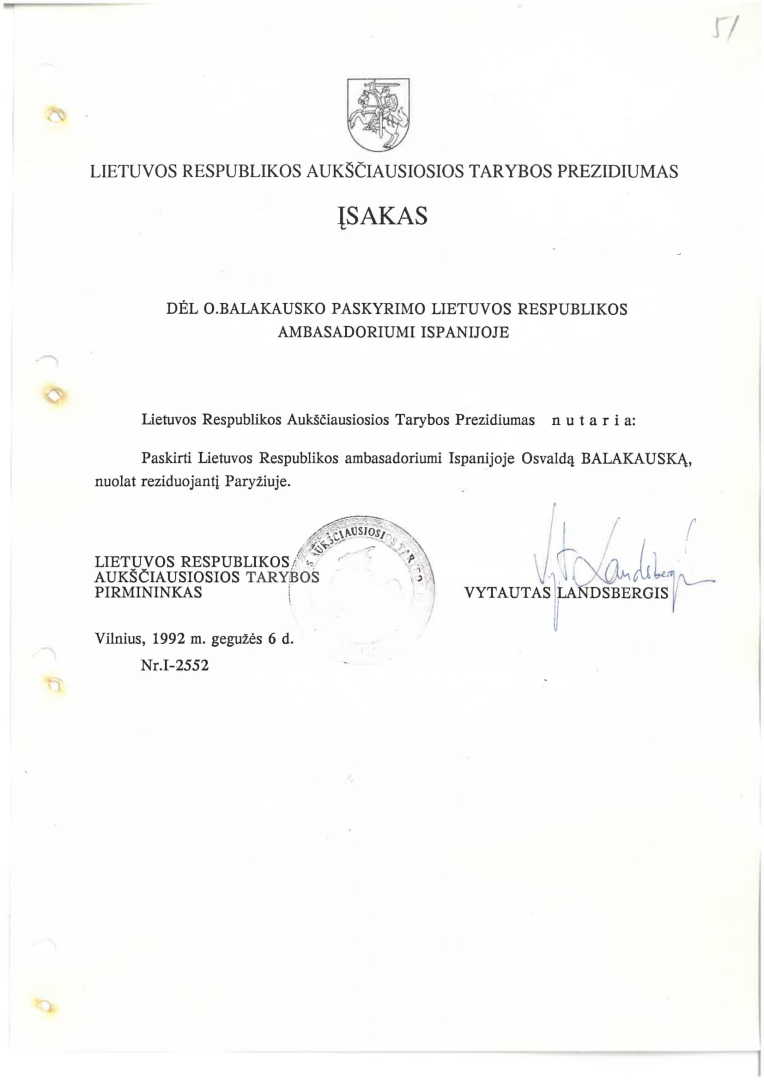
Decree of the Presidium of the Supreme Council of the Republic of Lithuania appointing composer Osvaldas Balakauskas, a member of the Council of the Reform Movement of Lithuania, as the first Ambassador of the Republic of Lithuania to Spain. The diplomat resided in Paris and represented Lithuania in France, Spain and Portugal. Vilnius, Lithuania, 6 May 1992. Archive of Seimas of the Republic of Lithuania, f. 2, ap. 1, b. 82, l. 51.

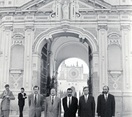
Visit to Spain by deputies of the Supreme Council of the Republic of Lithuania From left: second – Chairman of the Supreme Council of the Republic of Lithuania Prof. Vytautas Landsbergis, fourth – Vice-Minister of Culture and Education of the Republic of Lithuania Kornelijus Platelis. Seville, Spain, 1992, Photographer Raimundas Šuika Lithuanian Central State Archives.

100 years of diplomatic relations between Lithuania and Spain

Lithuania and Spain are partners in Europe and the World

The Lithuanian Embassy in Madrid was established in 1994, while Spain established its Embassy in Vilnius in 2004. In that year, Lithuania joined the EU and NATO, and economic, political and military cooperation between Lithuania and Spain began. Since then, the Spanish Air Force has been regularly deployed in NATO air policing missions to ensure the security of the Baltic States, and Lithuanian border guards have been working with other EU states to protect the southern borders of the EU states. The Embassy of Spain in Lithuania regularly organises Spanish Culture Days in Vilnius, Spanish is taught in Lithuanian schools and universities, Spanish and Lithuanian students participate in the ERASMUS exchange programme, and there is cooperation in the business sector as well.

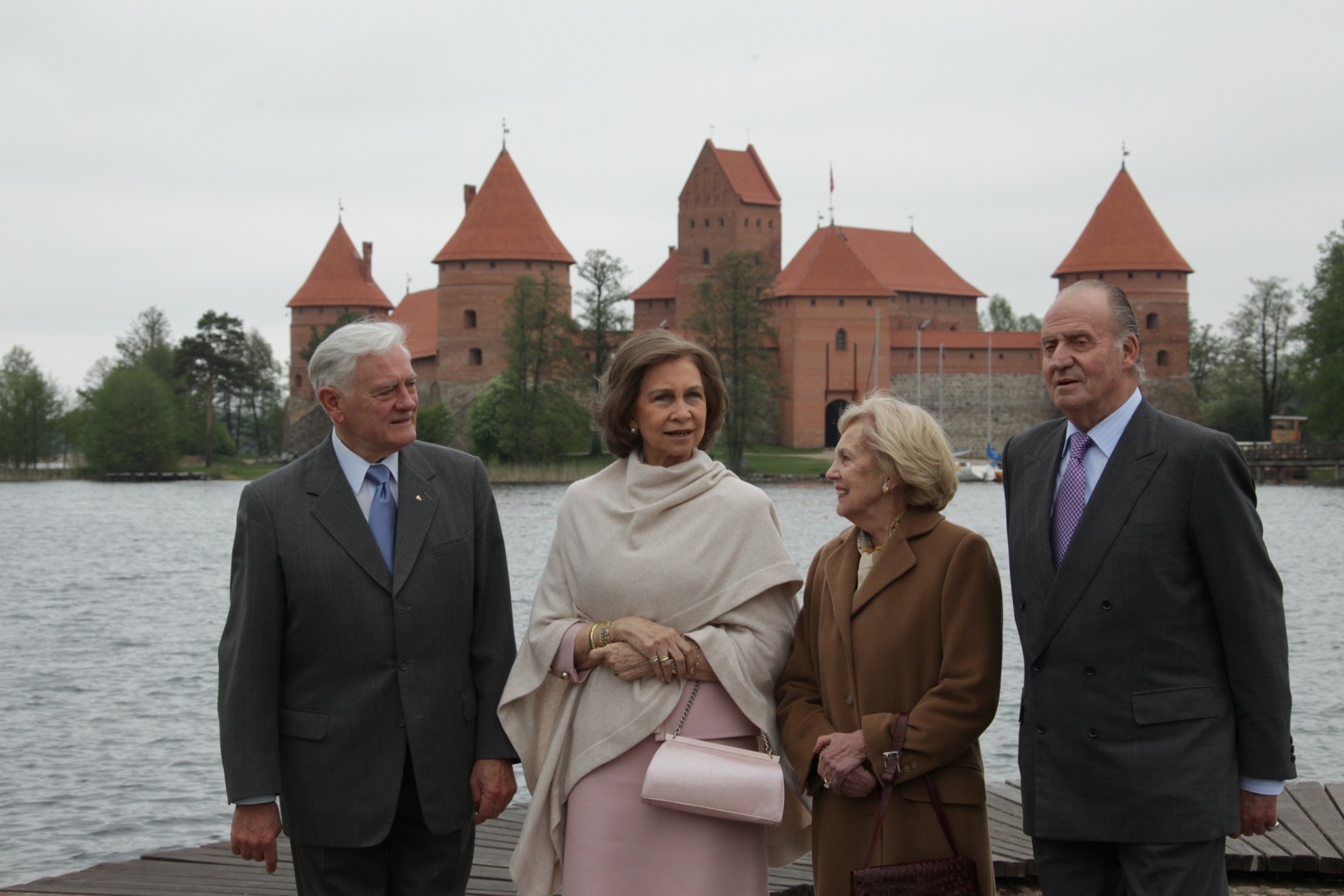
State visit of Their Majesties King Juan Carlos I and Queen Sofia of Spain to Lithuania From left: President of the Republic of Lithuania Valdas Adamkus, Queen Sofia of Spain, Alma Adamkienė, King Juan Carlos I of Spain. Trakai, Lithuania, 7 May 2009 | Photographer Džoja Gunda Barysaitė Office of the President of the Republic of Lithuania.

President of the Republic of Lithuania Dalia Grybauskaitė and King Felipe VI of Spain congratulate the players of the Lithuanian national team During her working visit to France, President of the Republic of Lithuania Dalia Grybauskaitė also watched the final match of the FIBA European Championship in Lille. The Lithuanian and Spanish national teams met in the final. Lille, France, 20 September 2015. | Photographer Robertas Dačkus Office of the President of the Republic of Lithuania.

100 years of diplomatic relations between Lithuania and Spain

Lithuania and Spain are partners in Europe and the World

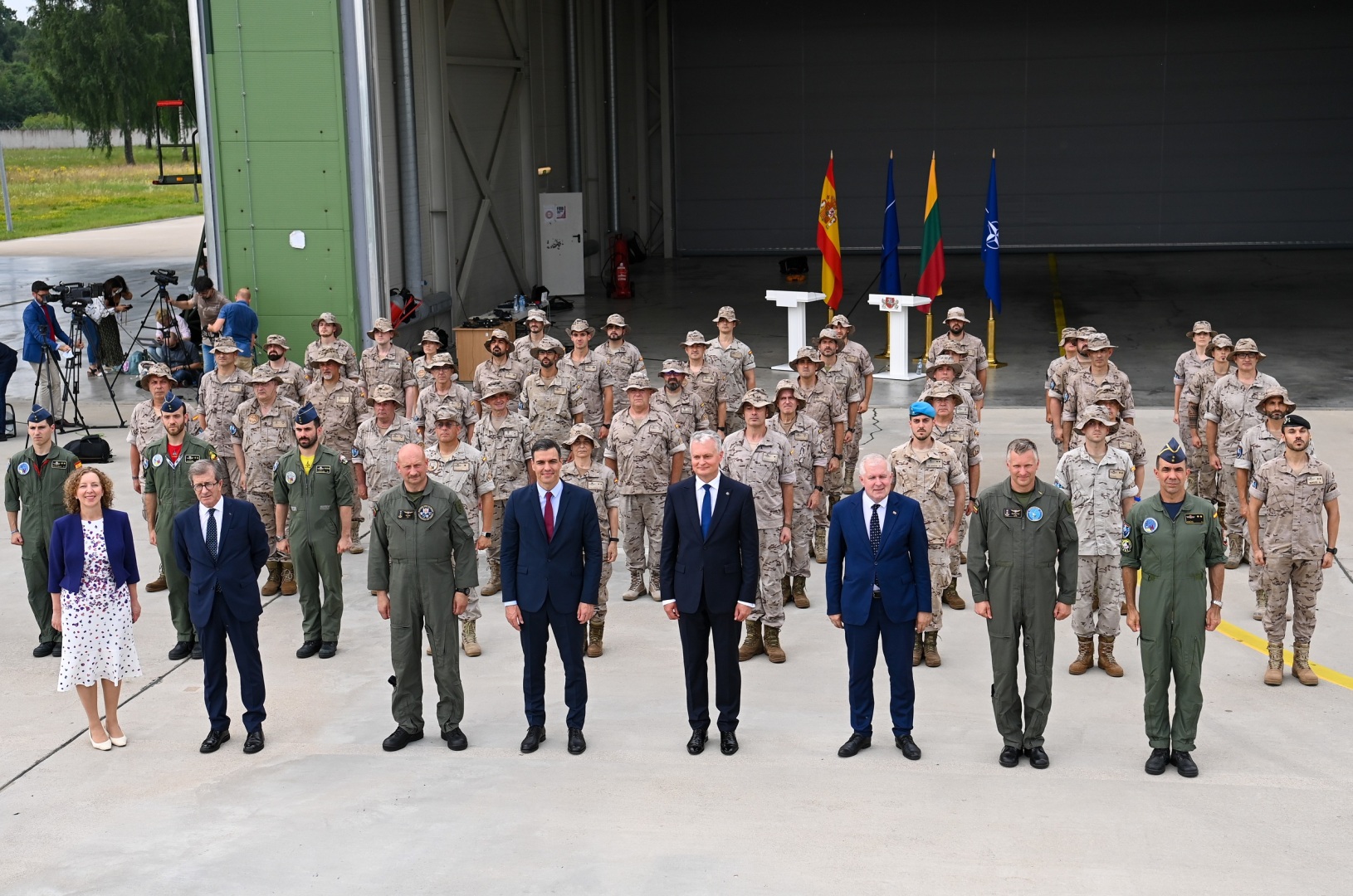
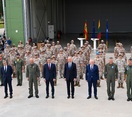
Visit of President of the Republic of Lithuania Gitanas Nausėda and Prime Minister of the Kingdom of Spain Pedro Sánchez to the Lithuanian Air Force Base at Šiauliai, where they met with Spanish soldiers serving in the NATO Air Policing Mission in Lithuania Šiauliai, Lithuania, 8 July 2021 | Photographer Robertas Dačkus. Office of the President of the Republic of Lithuania.

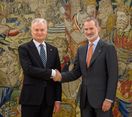
Working visit of President of the Republic of Lithuania Gitanas Nausėda to the Kingdom of Spain. President Gitanas Nausėda meets with King Felipe VI of Spain 30 June 2022 | Photographer Robertas Dačkus Office of the President of the Republic of Lithuania.

Lt En