*virtualexhibitions_ranking_title*

*apsaugos_kodas*
*alt_phpcaptcha_generated_image*
Loading
*virtualexhibitions_rank_submit_message*

{{msg}}

AUSTRALIAN LITHUANIANS. PART 2

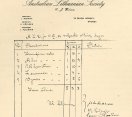
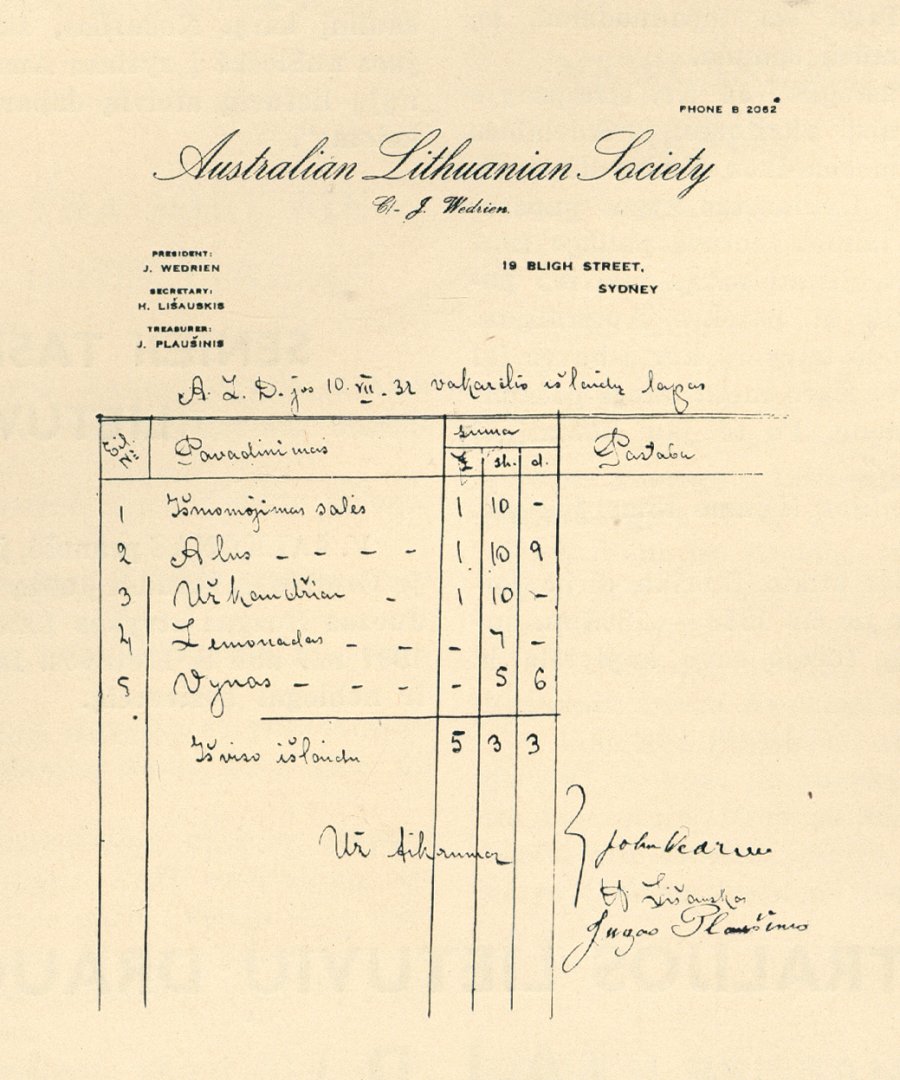
Expenditure Sheet for the Australian Lithuanian Society (ALS) Party

Sydney, July 10, 1931

The first organization aimed at uniting Lithuanians in Australia was established in 1929.

The teacher J. Jasiunas and railway official D. Dapkus, living in Sydney, found active supporters of Lithuanian heritage – J. Viedrinaitis and K. Skierius. On October 27, 1929, gathered at J. Viedrinaitis' apartment, they decided to establish the Australian Lithuanian Society, with the goal of uniting all Lithuanians in Australia, fostering closer connections, and promoting national spirit.

The Australian Lithuanian Society (ALS) operated from 1929 to 1950. In 1933, it had about 100 members. The society organized celebrations of national holidays, outings, and parties. At the end of 1947, Lithuanian refugees who had arrived from Germany quickly joined the ranks of the ALS members.

In 1948, a ALS branch was established in Melbourne. On December 30, 1948, the first ALS general assembly was held in Sydney. By 1949, ALS had 10 branches.

On December 30, 1949, the second ALS general assembly was held in Sydney, where it was decided to join the newly forming Lithuanian World Community.

On July 28, 1950, the ALS Central Board decided at its meeting to join the Lithuanian World Community from that day onwards, and on August 1, at another meeting, it was decided to refer to itself as the Provisional Organizational Committee of the Australian Lithuanian Community.

The Lithunian Yearbook of Australia. Volume I. Sydney, 1961

AUSTRALIAN LITHUANIANS. PART 2

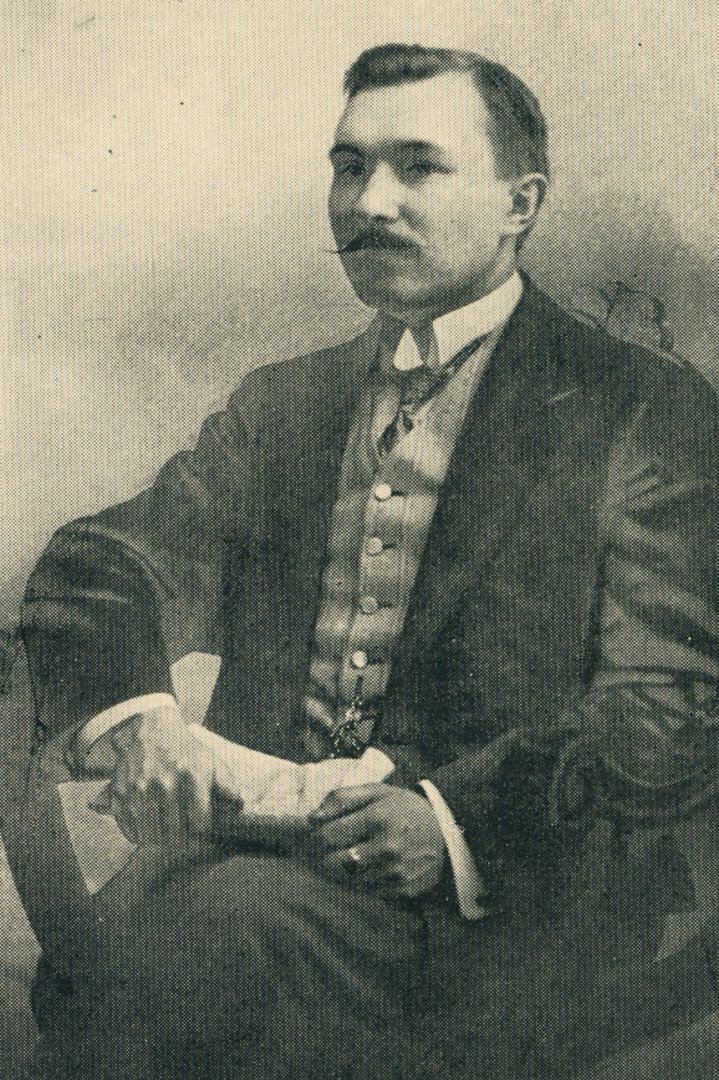
Jonas Viedrinaitis (John Wedrien) – First Chairman of the Australian Lithuanian Society

Jonas Viedrinaitis (1885–1955) arrived in Australia in 1913 from England. After emigrating from Lithuania, he studied tailoring in Manchester and later moved to Scotland before coming to Australia. In Sydney, he owned his own tailor shop.

Jonas Viedrinaitis served as the chairman of the Australian Lithuanian Society from 1929 to 1931 and again from 1937 to 1939.

The Lithunian Yearbook of Australia. Volume I. Sydney, 1961

AUSTRALIAN LITHUANIANS. PART 2

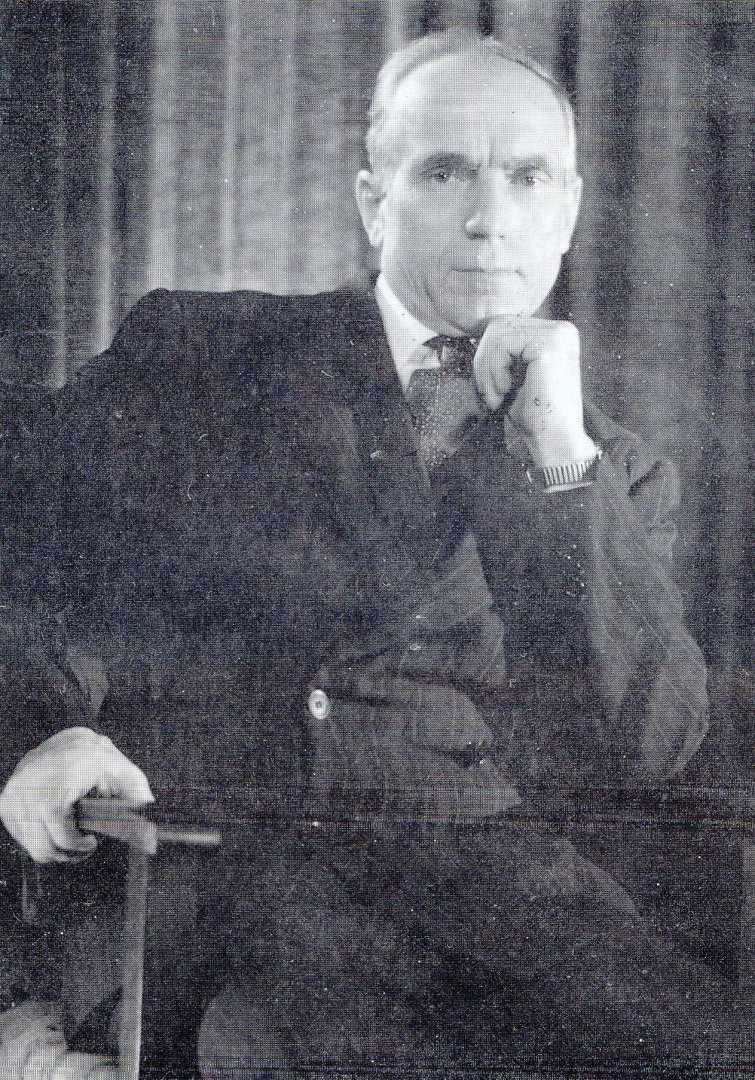
Antanas Bauze – Chairman of the Australian Lithuanian Society, Public Figure

Antanas Bauze (1898–1975) joined the Lithuanian army as a volunteer in 1919, serving for 11 years. In 1930, he arrived in Sydney with his wife, Ona Vysniauskaite, who had grown up in Scotland. Soon after, he bought a store and worked as a shopkeeper for 22 years, later acquiring a real estate buying and selling agency.

From 1932 to 1937 and again from 1940 to 1950, he served as the chairman of the Australian Lithuanian Society. In 1950, together with S. Narusius and J. Kapocius, he reorganized the Australian Lithuanian Society into the Australian Lithuanian Community.

Since 1950, he became an honorary member of the Australian Lithuanian Community. He was the initiator and official publisher of the weekly newspaper “Mūsų pastogė”.

The Lithunian Yearbook of Australia. Volume I. Sydney, 1961

AUSTRALIAN LITHUANIANS. PART 2

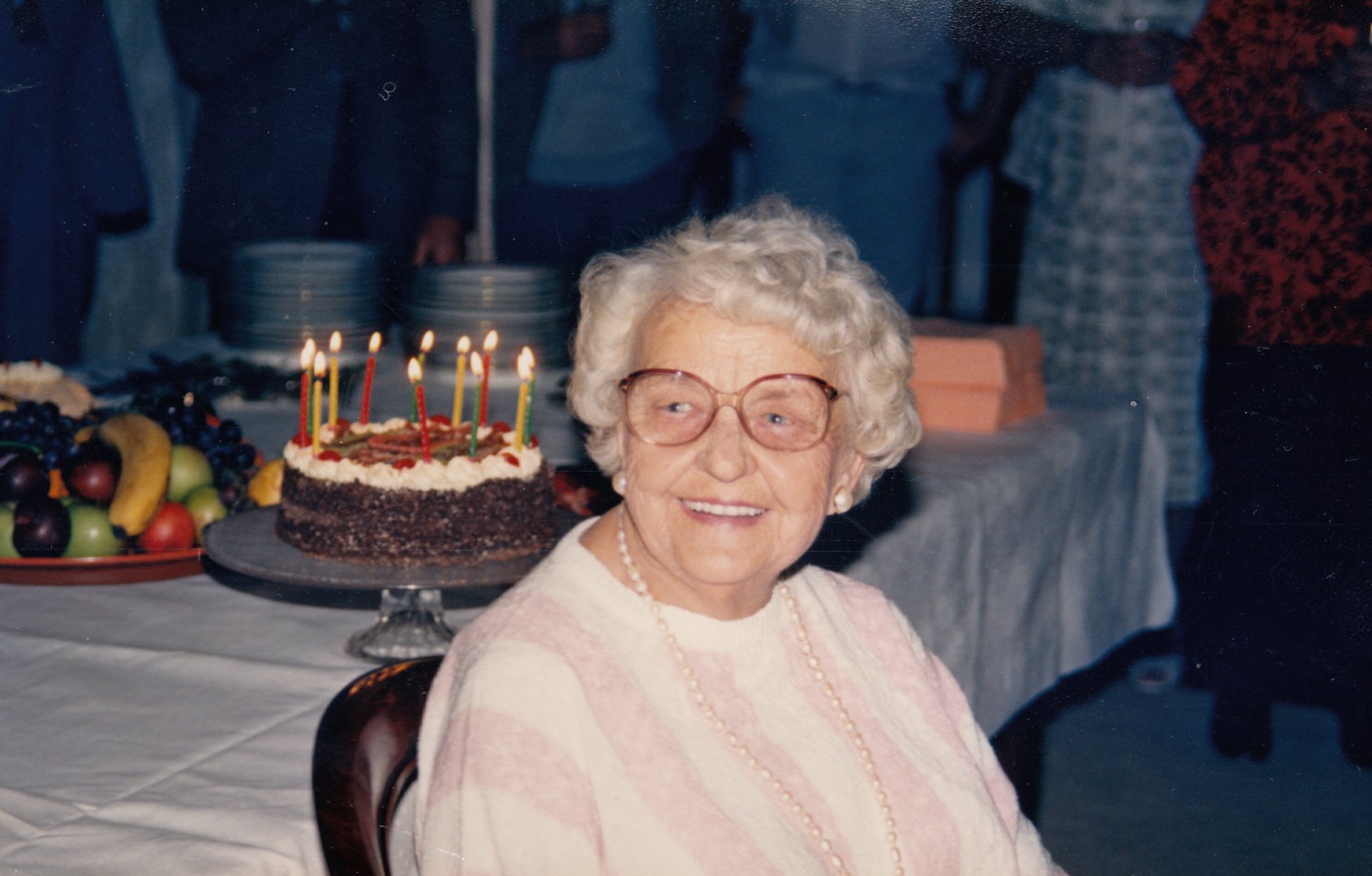
Ona Bauziene – Founder of the Australian Lithuanian Community, Public Figure, Wife of Antanas Bauze (1988)

Ona Vysniauskaite, later Bauziene (1904–2003), was born in Germany and grew up in Scotland, where she completed her education: high school and teacher training courses. In 1922, her family returned to Lithuania, where she worked at the Vilkaviskis Peace Court. While in Lithuania, she met and married Antanas Bauze in 1927. In 1930, they moved to Australia and settled in Sydney.

Ona and her husband were pioneers of the Australian Lithuanian Community. They actively assisted migrants who arrived after World War II, becoming leaders of the emerging Australian Lithuanian Community both in Sydney and beyond. Ona Bauziene briefly served as the administrator of the “Mūsų pastogė” newspaper and, especially during the early years of immigration, was always eager to help Lithuanians: she found apartments for some, jobs for others. Fluent in both Lithuanian and English, she also worked as a translator in courts.

From 1962 to 1984, she was the chairwoman of the Sydney Lithuanian Social Welfare Society. In 1970, at her initiative, the “Lietuvių sodyba” (Lithuanian House) was built in Sydney, providing housing for the elderly and pensioners. She became an honorary member of the Australian Lithuanian Community in 1976.

In 1983, Queen Elizabeth II awarded Ona Bauziene the British Empire Medal for her contributions to the Australian Lithuanian Community.

After her husband’s death, she moved to Adelaide, volunteered at the library, and continued writing articles for the Lithuanian press in Australia. In her 90s, she wrote her biography, “Mano gyvenimo prisiminimai” (My Life’s Memories). She passed away at the age of 99.

Australian Lithuanian Archives

AUSTRALIAN LITHUANIANS. PART 2

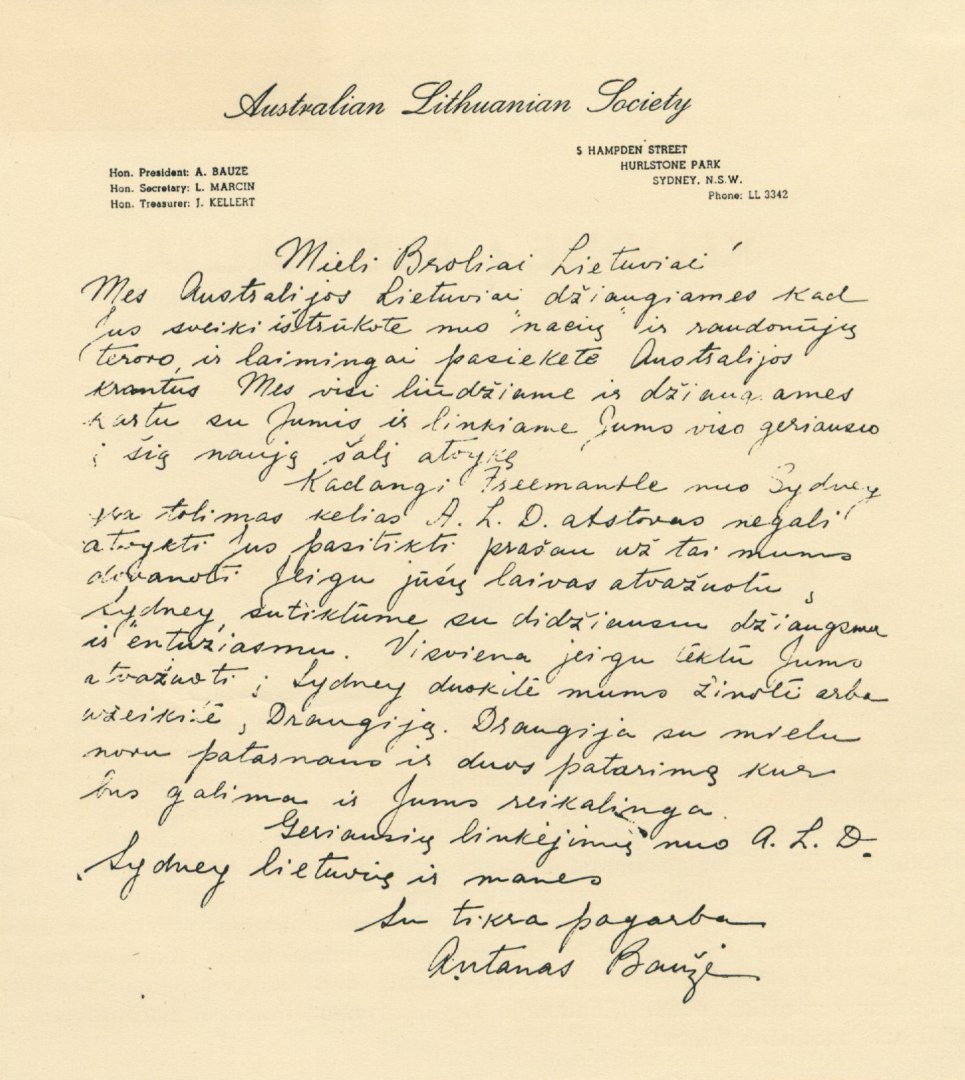
Message from the Chairman of the Australian Lithuanian Society, Antanas Bauze, to Lithuanian Refugees Arriving on the First Lithuanian Transport

Sydney, 1947

The Chairman of the Australian Lithuanian Society, A. Bauze, addressed the Lithuanians with the following words:

"Dear brothers and sisters, we, the Lithuanians of Australia, are happy that you have safely escaped from the terror of the Nazis and the Reds and have successfully reached the shores of Australia. We share in your sadness and joy and wish you all the best <...>. Since Fremantle is far from Sydney, the representative of the Australian Lithuanian Society is unable to come to greet you, please forgive us for this <...>. Nevertheless, if you happen to come to Sydney, please let us know or drop by the society. The society will be more than happy to assist and provide advice <...>."

The Lithunian Yearbook of Australia. Volume I. Sydney, 1961

AUSTRALIAN LITHUANIANS. PART 2

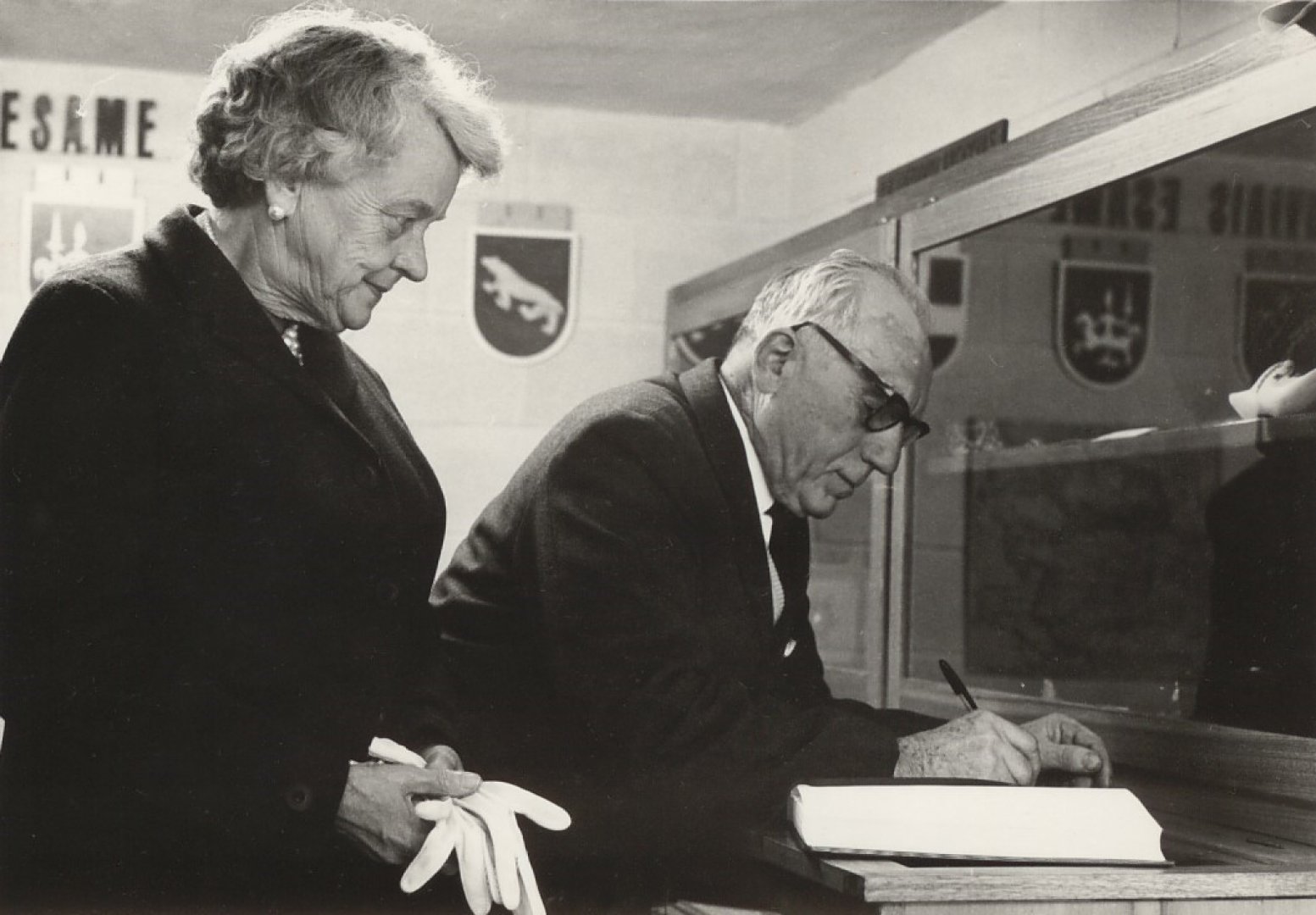
Honorary Member of the Australian Lithuanian Community, Antanas Bauze, with his wife Ona, visits the Australian Lithuanian Archives and signs the guestbook

Adelaide, 1966

Australian Lithuanian Archives, document No. PH0662a

AUSTRALIAN LITHUANIANS. PART 2

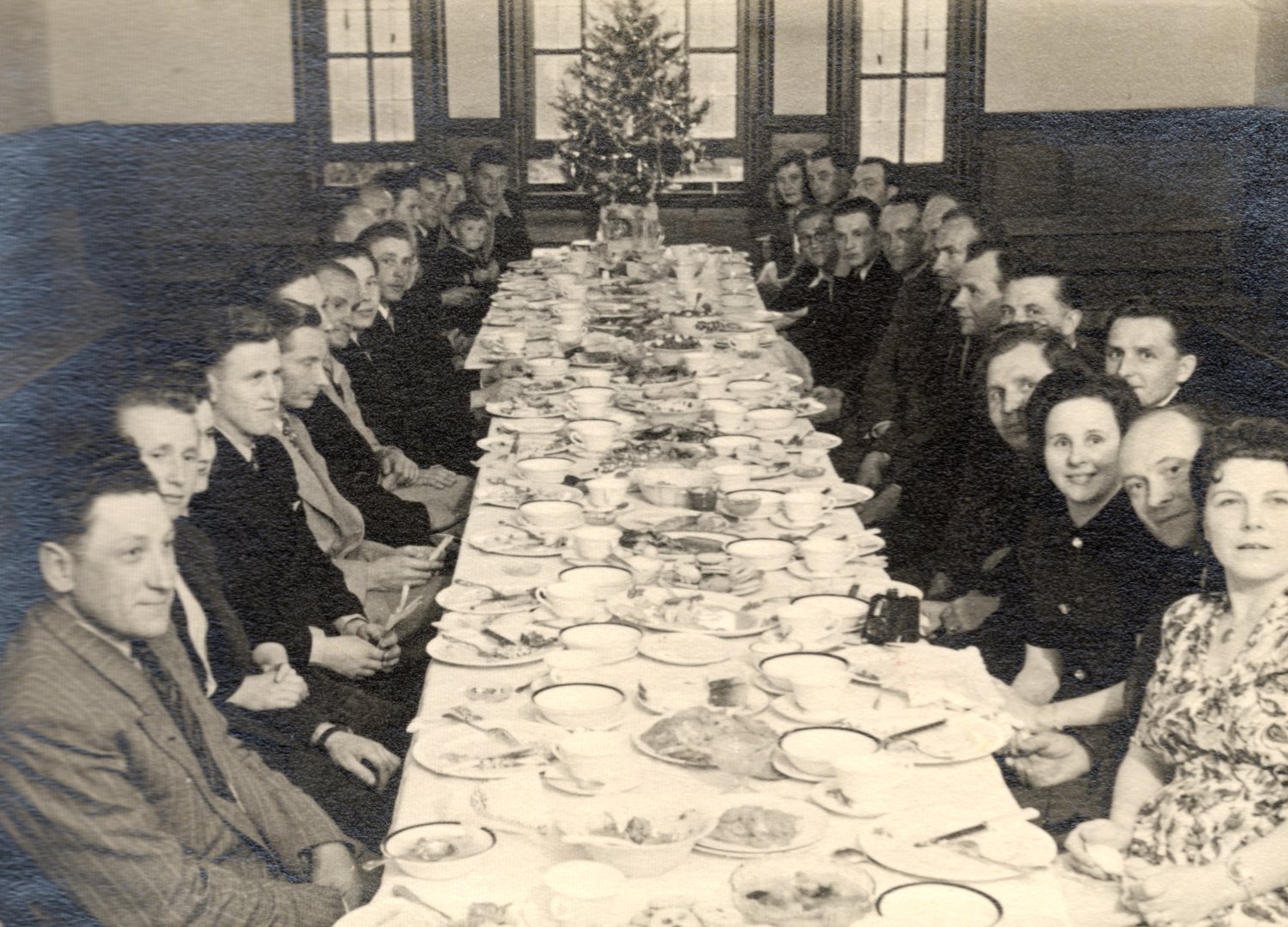
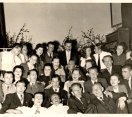
Lithuanians of Geelong at the Christmas Eve Dinner

Geelong, 1949

A photograph saved in the Australian Lithuanian Archives attests to the history of Lithuanian settlement in Geelong. Geelong is a coastal area near Melbourne. The first Lithuanians arrived in Geelong in 1949. The first to come to the city were Lithuanian women, who were assigned to work in hospitals, hotels, and the homes of wealthy people. By the end of 1949, there were nearly a hundred Lithuanians in Geelong.

In 1949, a communal Christmas Eve dinner was held in the St. Peter and Paul Parish Hall, after which it was decided to establish a branch of the Australian Lithuanian Society (ALS). The founding meeting of the ALS branch took place on January 22, 1950.

By 1951, there were already 320 Lithuanians living in Geelong.

In the Bell Park suburb of Geelong, there is still Kaunas Street. Nearby is Libau Street (named after the Latvian city of Liepāja), Tallinn Street (named after the Estonian capital), and Vysla Street (named after the largest river in Poland, the Vistula).

Australian Lithuanian Archives, photo album „Lithuanians in Australia“

AUSTRALIAN LITHUANIANS. PART 2

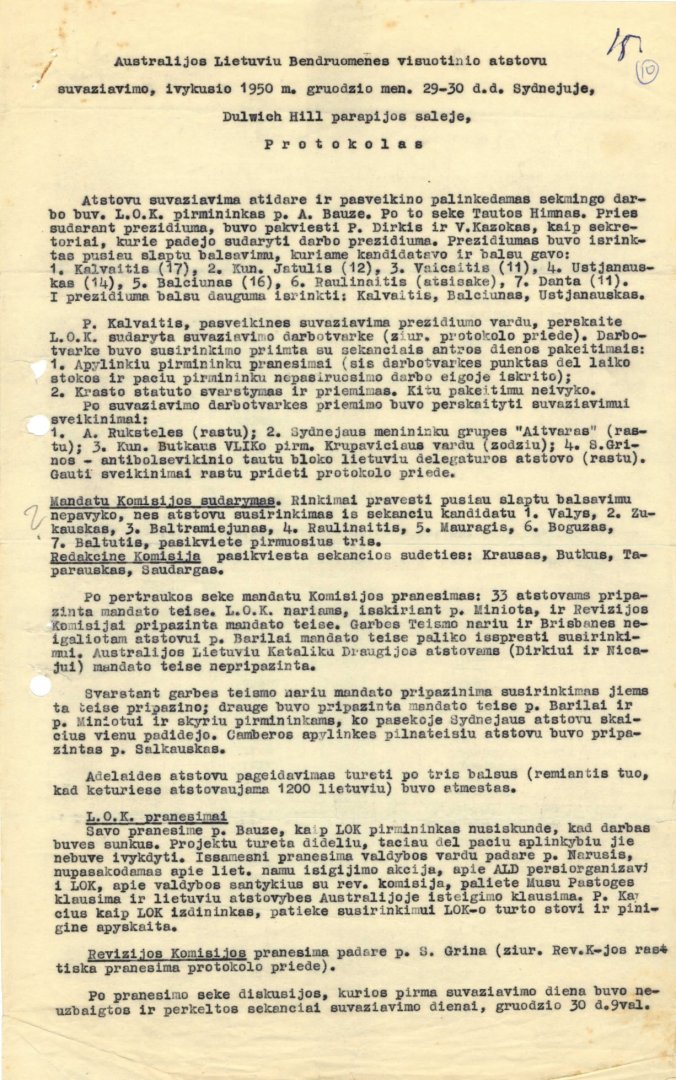
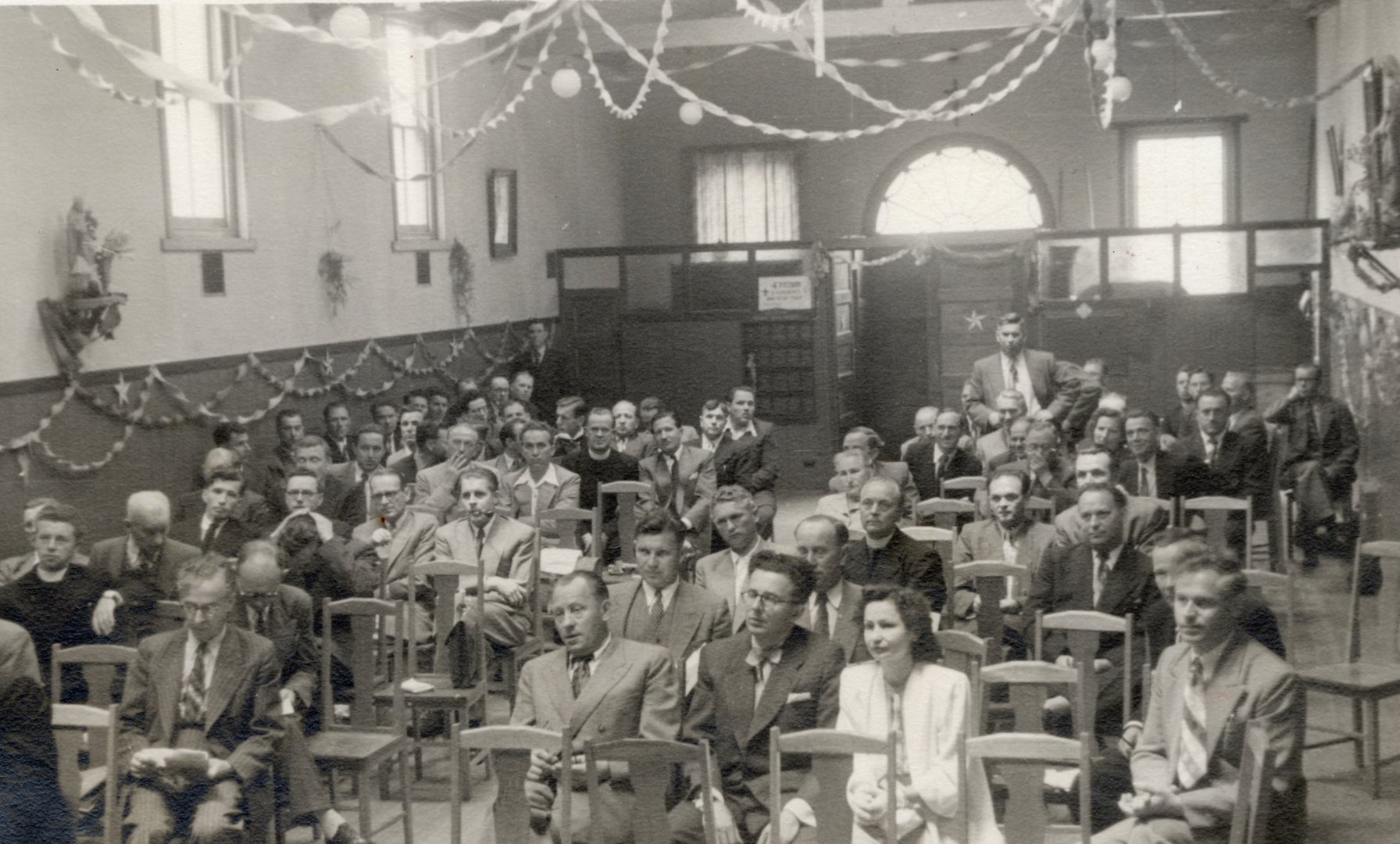
Report on the First General Representatives' Assembly of the Australian Lithuanian Community, held on December 29–30, 1950, in Sydney (Dulwich Hill Parish Hall)

Lithuanians who arrived in Australia, fearing they would disperse across the vast territories of the country, felt the need to unite and organise. At the same time, the idea arose in the United States to establish a national community that would unite Lithuanians who had found themselves around the Western world after World War II, as well as those who had emigrated earlier.

In 1950, the Executive Board of the Supreme Committee for the Liberation of Lithuania (Lithuanian: Vyriausiasis Lietuvos išlaisvinimo komitetas or VLIK), based in Germany and chaired by Prelate Mykolas Krupavicius, began urging Lithuanians in Australia to join the Lithuanian World Community. Since the Australian Lithuanian Society (ALS) was already active in Australia, M. Krupavicius reached out to the ALS chairman, Antanas Bauze, asking him to take on the role of the chairman of the Australian Lithuanian Community and to reorganize the ALS with its branches into the Australian Lithuanian Community (ALC). It was also proposed to organise the community in Adelaide under the leadership of the artist Antanas Rukstele. However, duality was avoided, and the ALS board, by its decision on July 28, 1950, announced in the press to all Lithuanians in Australia, took the primary step toward reorganising into the ALC.

From August 1, 1950, the ALS changed its name and became the Australian Lithuanian Community (ALC).

The dates of December 29–30, 1950, should be considered historic in the life of the Lithuanian community in Australia. Representatives from all community districts were present at the assembly, with the exception of those from the farthest districts - Tasmania and Western Australia.

Council meetings were held in the local Catholic parish hall of Dulwich Hill, a suburb of Sydney. The Presidium elected were: chairman Jonas Kalvaitis (Adelaide) and two vice-chairmen – Silvestras Balciunas (Melbourne) and Antanas Ustijanauskas (Sydney). The first regular session of the National Council saw much discussion, proposals, and ideas. The issue of Lithuanian youth, education in the Lithuanian language was already being raised, and there was much talk about the press. It was proposed to centralise Lithuanian cultural activities through district boards, which were to establish Lithuanian language schools, folk dance groups, choirs, youth sports sections, and more.

Australian Lithuanian Archive
AUSTRALIAN LITHUANIANS. PART 2

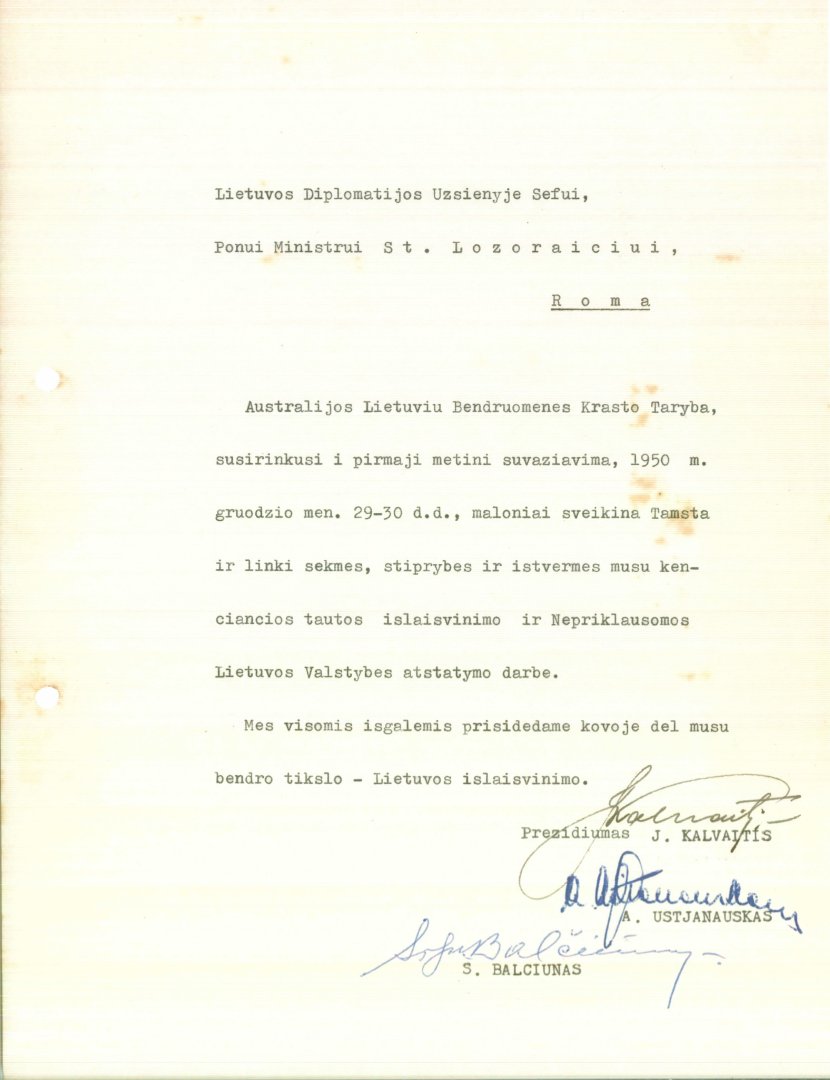
Greeting from the National Council of the Australian Lithuanian Community (ALC) to the Head of Lithuanian Diplomacy, Stasys Lozoraitis

Sydney, December 29–30, 1950

Lithuanian Central State Archives, archive No. 668, summary No. 1, file No. 226, page 3
AUSTRALIAN LITHUANIANS. PART 2

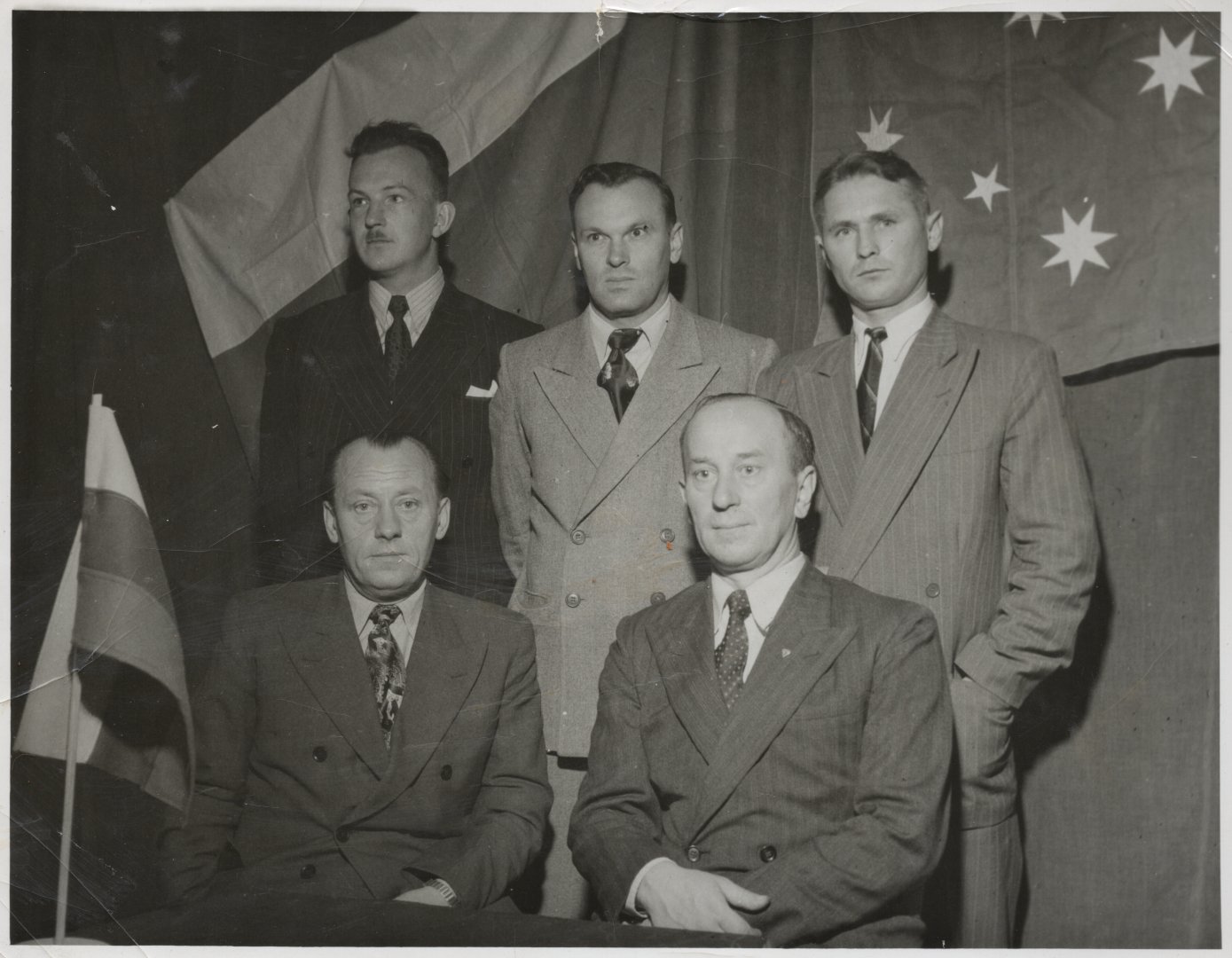
Board of the Adelaide District of the Australian Lithuanian Community (ALC)

Seated: Jonas Kalvaitis (Chairman), Vincas Cepliauskas.

Standing: Leonas Gerulaitis, Jonas Mockunas, Kazys Taparauskas (Secretary).

Adelaide, 1950

Although the first Lithuanians reached South Australia and its capital, Adelaide, much earlier, the community grew and began to consolidate with the arrival of the so-called first and second Lithuanian transports in 1948.

On February 16, 1948, Lithuania’s Independence Day was celebrated for the first time in Adelaide.

By the end of 1948, there were over 100 Lithuanians in Adelaide.

On January 2, 1949, a group of initiators (Jonas Mockunas, Vincas Cepliauskas, Aleksandras Šliužas, and others) convened the first Lithuanian meeting in Adelaide.

On February 19, 1949, the first public celebration of Lithuania’s Independence Day was held in Adelaide, which was attended by local Australians. 1949 can be considered the most notable year of growth for the Lithuanian community in Adelaide. The initial community of 100 people grew to around 1,000 members.

In 1949, the Adelaide Lithuanian Cultural Society was founded to take care of the cultural and social needs of Lithuanians living in South Australia. However, on November 9 of the same year, the society changed its name. The Central Board of the Australian Lithuanian Society (ALS) registered the ALS Adelaide branch. After the reorganisation of the Australian Lithuanian Society according to the statutes of the Lithuanian World Community, the ALS Adelaide branch was reorganised into the Adelaide District of the Australian Lithuanian Community (ALC).

Australian Lithuanian Archives, photo album „Lithuanians in Australia“

AUSTRALIAN LITHUANIANS. PART 2

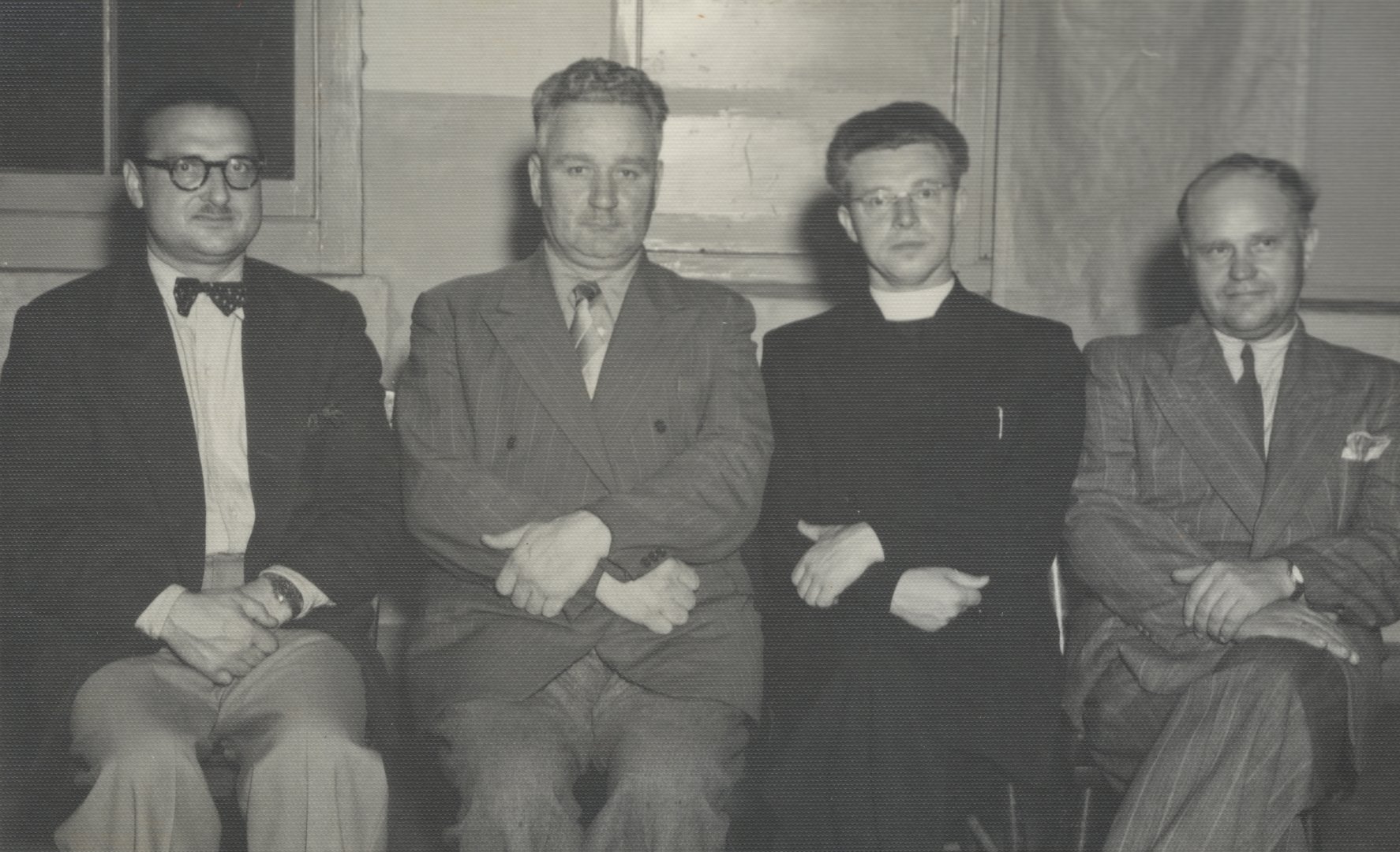
National Board of the Australian Lithuanian Community (ALC)

From left: Mykalojus Bogusas, Justinas Vaicaitis, Father Petras Butkus, Aleksandras Mauragis.

Sydney, 1951

In 1951, the first National Board of the Australian Lithuanian Community (ALC) divided responsibilities: Justinas Vaicaitis became the chairman, Father Petras Butkus was the vice-chairman, Antanas Ustijanauskas was the secretary, Mykalojus Bogušas was the treasurer, and Aleksandras Mauragis was the head of culture and arts. During its one-year term, this National Board held as many as 24 meetings.

Chairman Justinas Vaicaitis, in particular, devoted a great deal of time to community affairs, frequently attending events, gatherings, and encouraging the establishment of community branches and weekend schools.

Australian Lithuanian Archives, photo album „Lithuanians in Australia“

AUSTRALIAN LITHUANIANS. PART 2

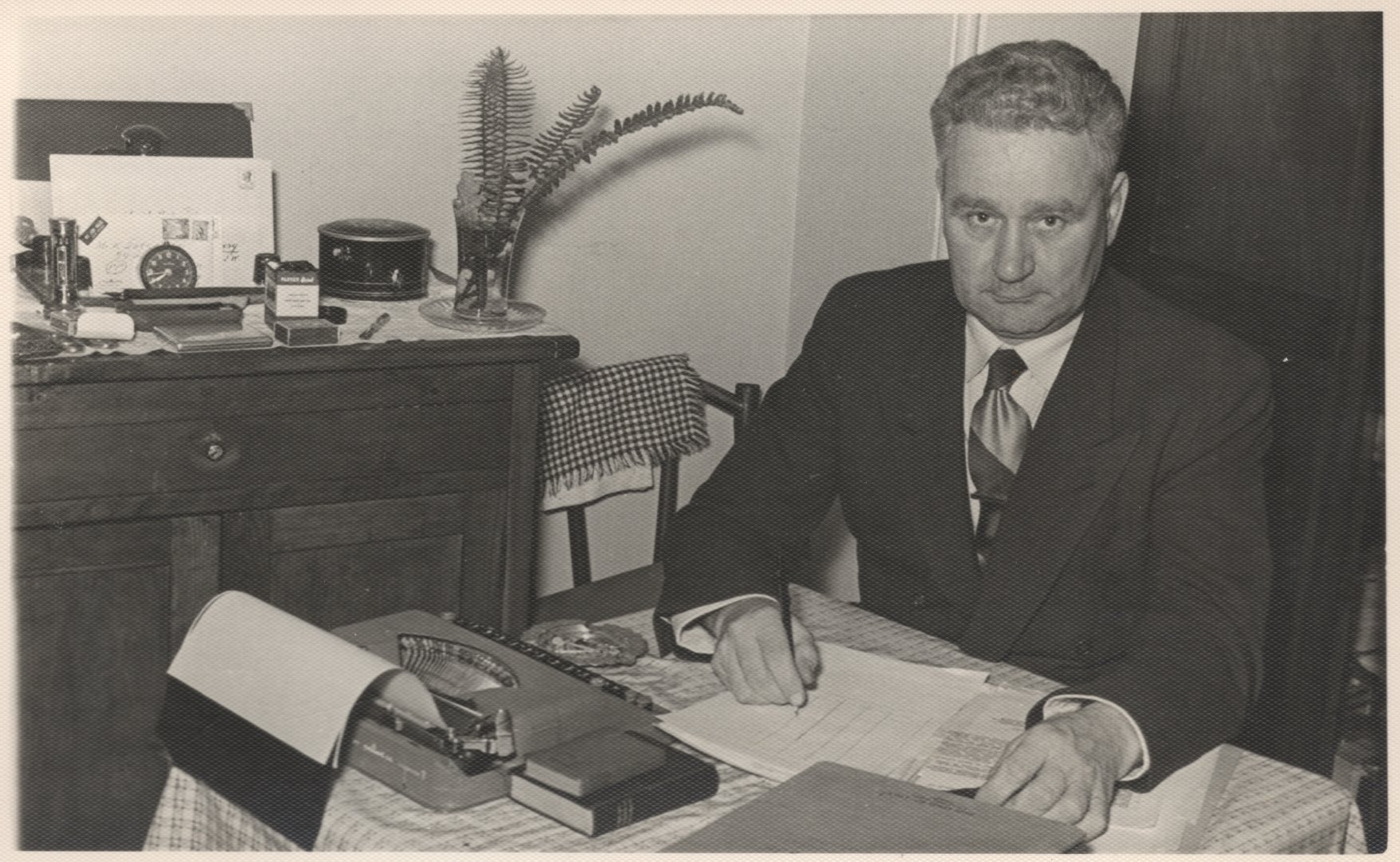
Chairman of the National Board of the Australian Lithuanian Community, Justinas Vaicaitis, at work in his apartment

Sydney, [1951–1953]

Justinas Vaicaitis (1904–1969) – Chairman of the National Board of the Australian Lithuanian Community (ALC) from 1951 to 1953. Vaicaitis was born in Stakiai, Raseiniai District. He attended high schools in Raseiniai and Kaunas, studying humanities and economics at Vytautas Magnus University. He actively participated in the activities of the organisations aimed at liberating Vilnius and the Riflemen's Union. He worked at the State Audit Office in Kaunas. After the Soviet occupation of Lithuania, J. Vaicaitis fled to Germany, moved to Switzerland in 1945, and later emigrated to Australia. He became actively involved in the activities of the Australian Lithuanian Community, serving as the chairman of the Sydney district board and later as the chairman of the National Board of the Australian Lithuanian Community, a position he held for several terms. At the end of 1953, he emigrated to the United States, where he became actively involved in the Lithuanian community in Boston.

Australian Lithuanian Archives, photo album „Lithuanians in Australia

AUSTRALIAN LITHUANIANS. PART 2

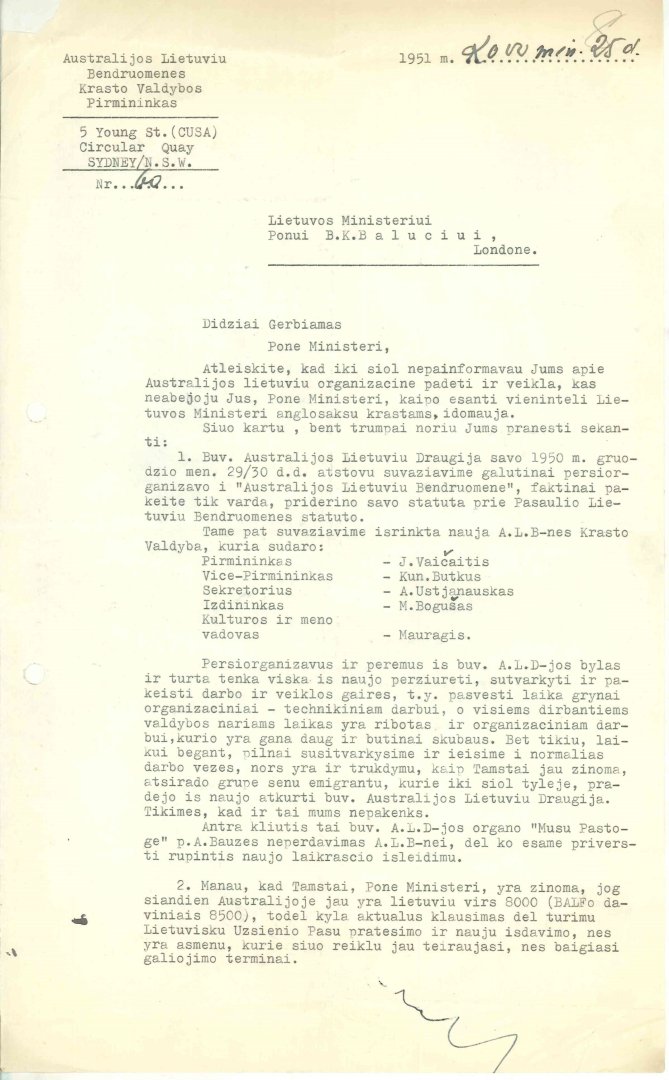
Report by Justinas Vaicaitis, Chairman of the National Board of the Australian Lithuanian Community, to the Lithuanian Representative in London, Bronius Kazys Balutis, on the Situation and Activities of Lithuanians in Australia

Sydney, March 25, 1951

Lithuanian Central State Archives, archive No. 648, summary No. 2, file No. 366, pages 8-9
AUSTRALIAN LITHUANIANS. PART 2

Presidium of the National Board of the Australian Lithuanian Community (ALC)

The session is opened by Jonas Valys, Chairman of the Presidium of the National Board of the Australian Lithuanian Community (ALC).

Melbourne, December 29–30, 1951

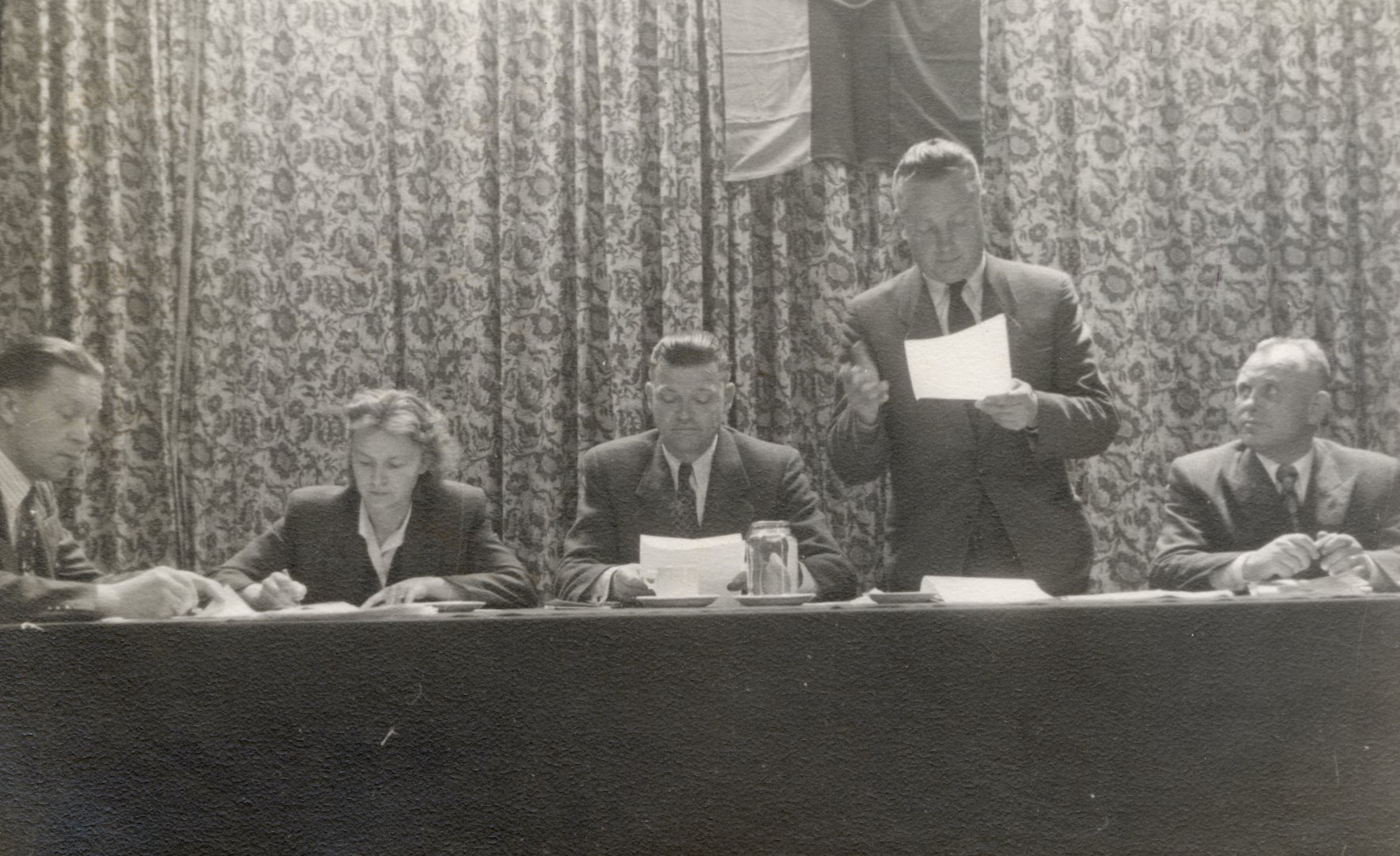
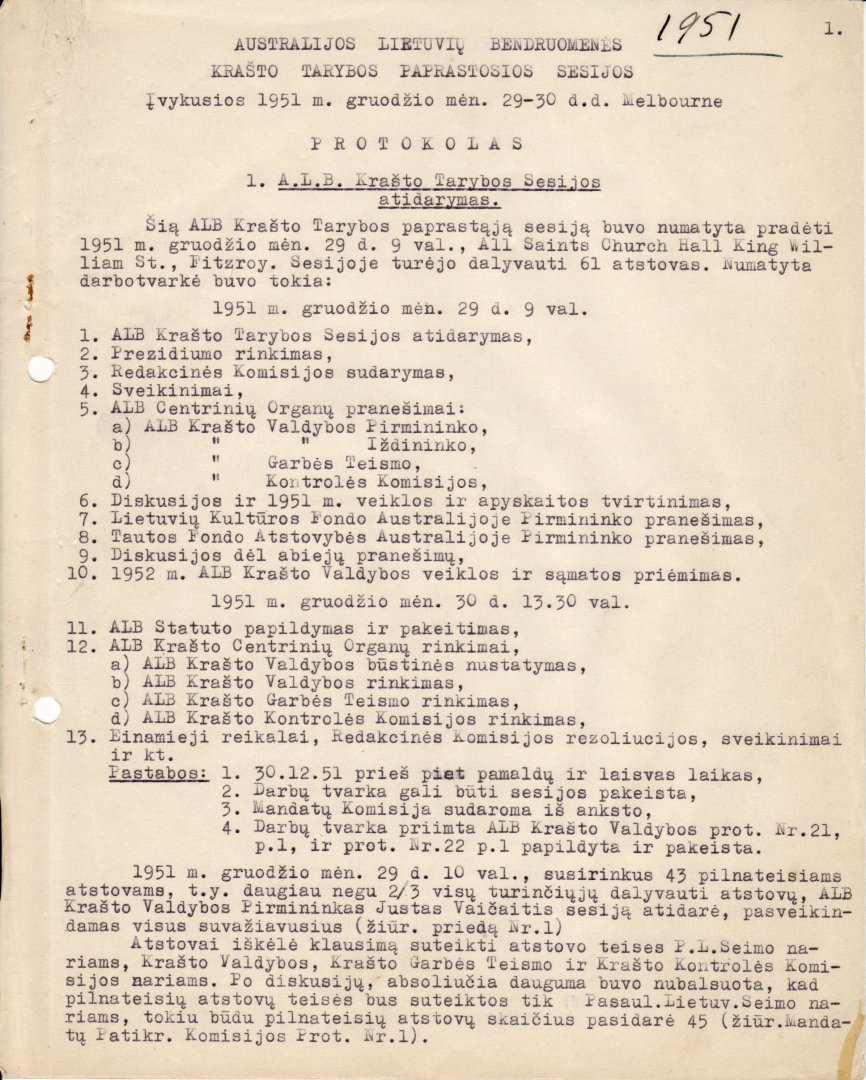
On December 29–30, 1951, the second session of the National Board of the Australian Lithuanian Community (ALC) took place in Melbourne. The new term of the National Board lasted one year. Various issues concerning the activities of Lithuanians in Australia were discussed, ideas for self-help were encouraged, donations for Lithuanians remaining in Germany were started to be collected, and Australian Lithuanian sports clubs were urged to become more active. The publication of the newspaper “Mūsų pastogė” was taken over.

Australian Lithuanian Archives, photo album „Lithuanians in Australia“

AUSTRALIAN LITHUANIANS. PART 2

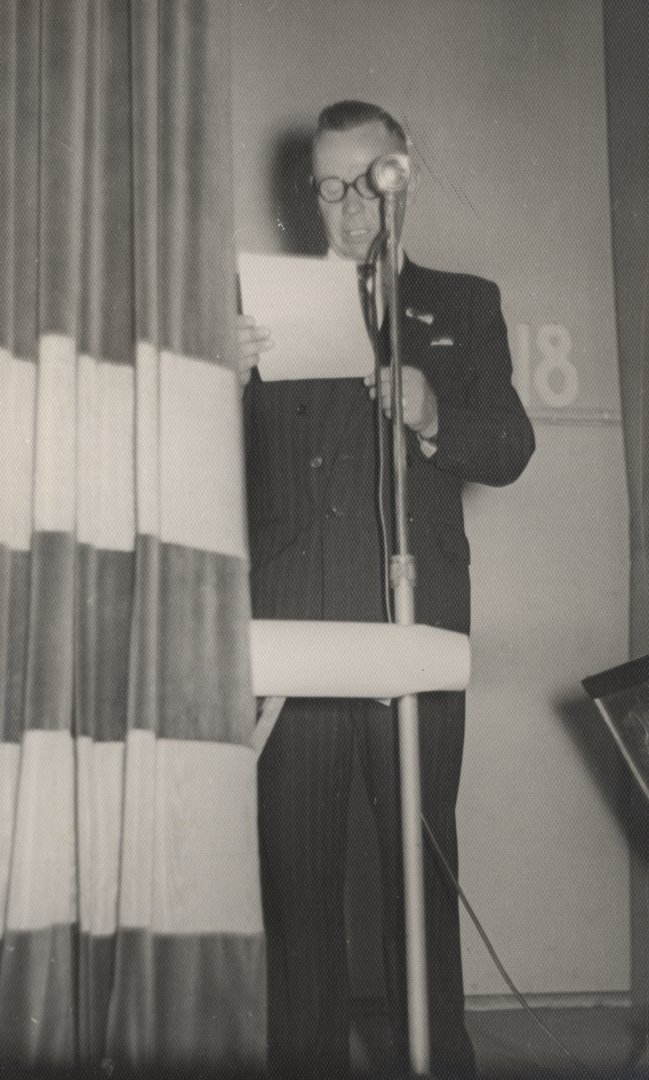
Second Session of the National Board of the Australian Lithuanian Community (ALC)

Speech by Justinas Vaicaitis, Chairman of the National Board of the Australian Lithuanian Community (ALC).

Melbourne, December 29–30, 1951

Australian Lithuanian Archives, photo album „Lithuanians in Australia“

AUSTRALIAN LITHUANIANS. PART 2

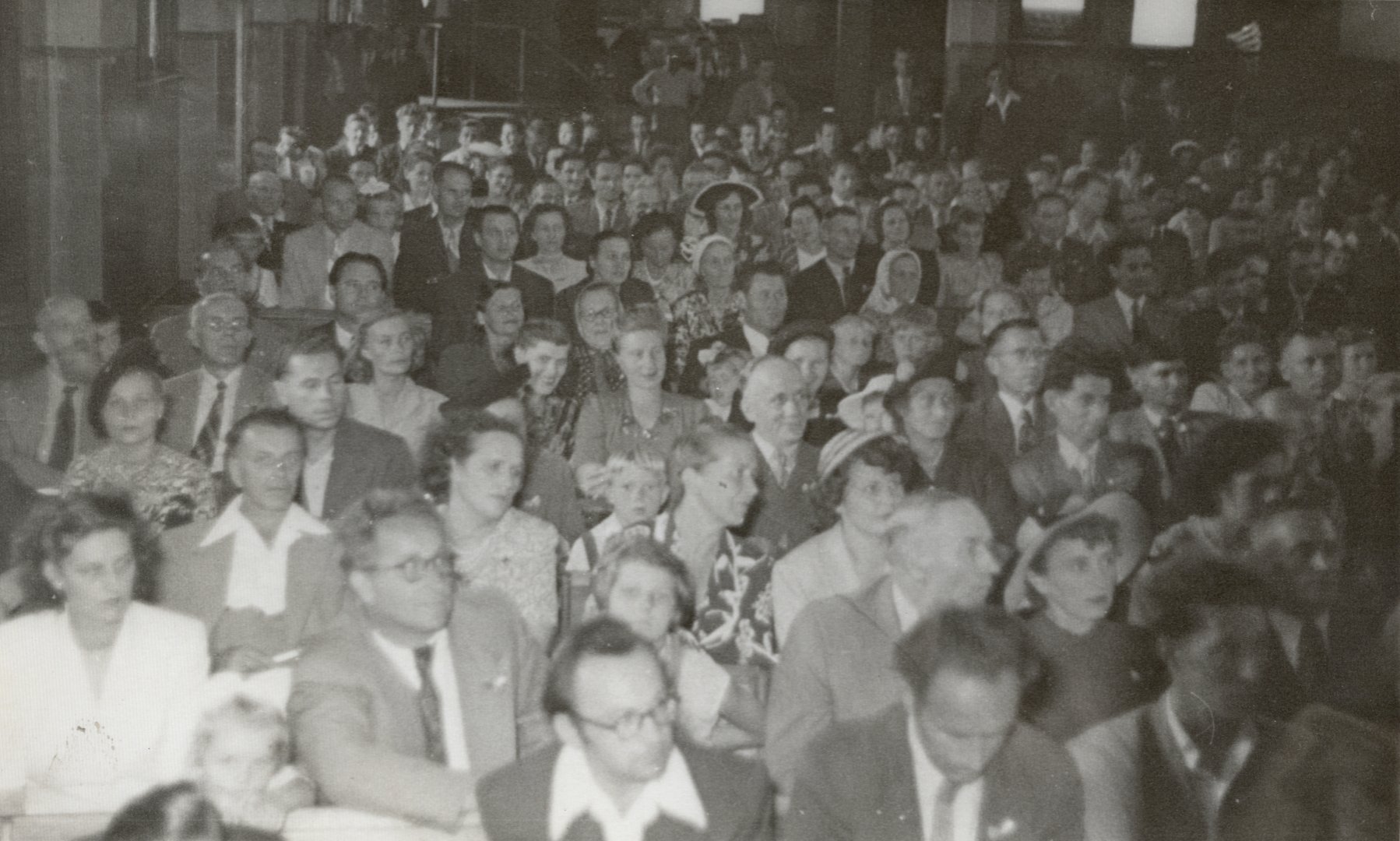
Second Session of the National Board of the Australian Lithuanian Community (ALC)

Melbourne, December 29–30, 1951

Australian Lithuanian Archives, photo album „Lithuanians in Australia“

AUSTRALIAN LITHUANIANS. PART 2

Second Session of the National Board of the Australian Lithuanian Community (ALC)

Melbourne, December 29–30, 1951

Australian Lithuanian Archives, photo album „Lithuanians in Australia“

AUSTRALIAN LITHUANIANS. PART 2

Second Session of the National Board of the Australian Lithuanian Community (ALC)

Speech by Juozas Lapsys, Chairman of the Adelaide District of the Australian Lithuanian Community (ALC).

Melbourne, December 29–30, 1951

Juozas Lapsys (1911–2001) – Lithuanian Army officer and active member of the Australian Lithuanian Community. He was born in Radviliskis and graduated from the Lithuanian Military School in Kaunas in 1933. He served in the 5th Infantry Regiment of the Lithuanian Grand Duke Kestutis Division. In 1939, he graduated from the Klaipeda Trade Institute and worked for the Lithuanian Baltic Lloyd shipping company. In 1944, he fled to the West and worked for the UNRA (United Nations Relief and Rehabilitation Administration).

He arrived in Australia in 1948. From 1952–1953, he led the Adelaide Lithuanian District Board of the Australian Lithuanian Community (ALC), later serving as the chairman of the Baltic Council for several years and as vice-chairman of the ALC National Board. In 1974, he contributed to a joint Baltic immigrants' effort to challenge Australian Prime Minister Gough Whitlam's decision to recognize Lithuania as part of the Soviet Union rather than an occupied country. Since 1974, he has been the representative of the Supreme Committee for the Liberation of Lithuania (lithuanian: Vyriausiasis Lietuvos išlaisvinimo komitetas or VLIK) in Australia. He became an honorary member of the Australian Lithuanian Community in 1978.

Australian Lithuanian Archives, photo album „Lithuanians in Australia“

Lithuanian Central State Archives, document No. P-00953

AUSTRALIAN LITHUANIANS. PART 2

Second Session of the National Board of the Australian Lithuanian Community (ALC)

Melbourne, December 29–30, 1951

Australian Lithuanian Archives, photo album „Lithuanians in Australia“

AUSTRALIAN LITHUANIANS. PART 2

Excerpt from the report of the Australian Lithuanian Community (ALC) Country Council Ordinary Session, held on December 29–30, 1951, in Melbourne

Australian Lithuanian Archives

AUSTRALIAN LITHUANIANS. PART 2

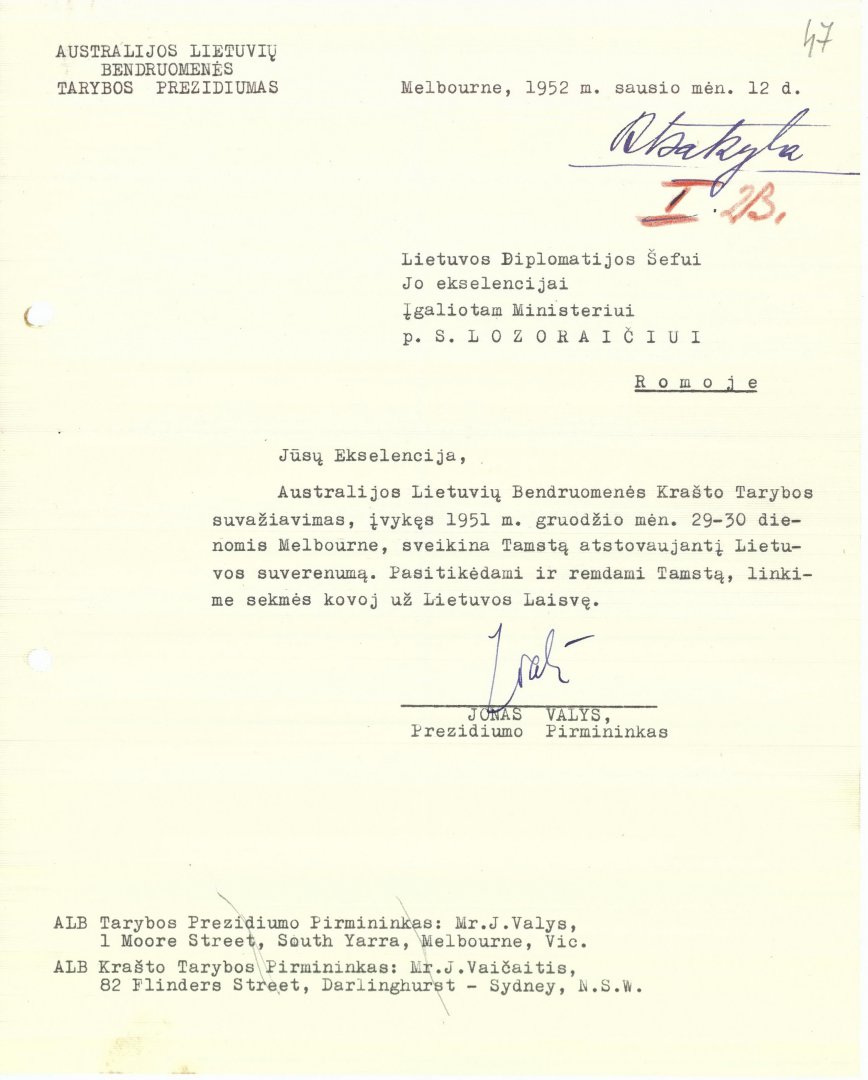
Greeting from the Australian Lithuanian Community (ALC) Country Council to the Head of Lithuanian Diplomacy, Stasys Lozoraitis

Melbourne, January 12, 1952

Lithuanian Central State Archives, archive No. 668, summary No. 1, file No. 396, page 47
AUSTRALIAN LITHUANIANS. PART 2

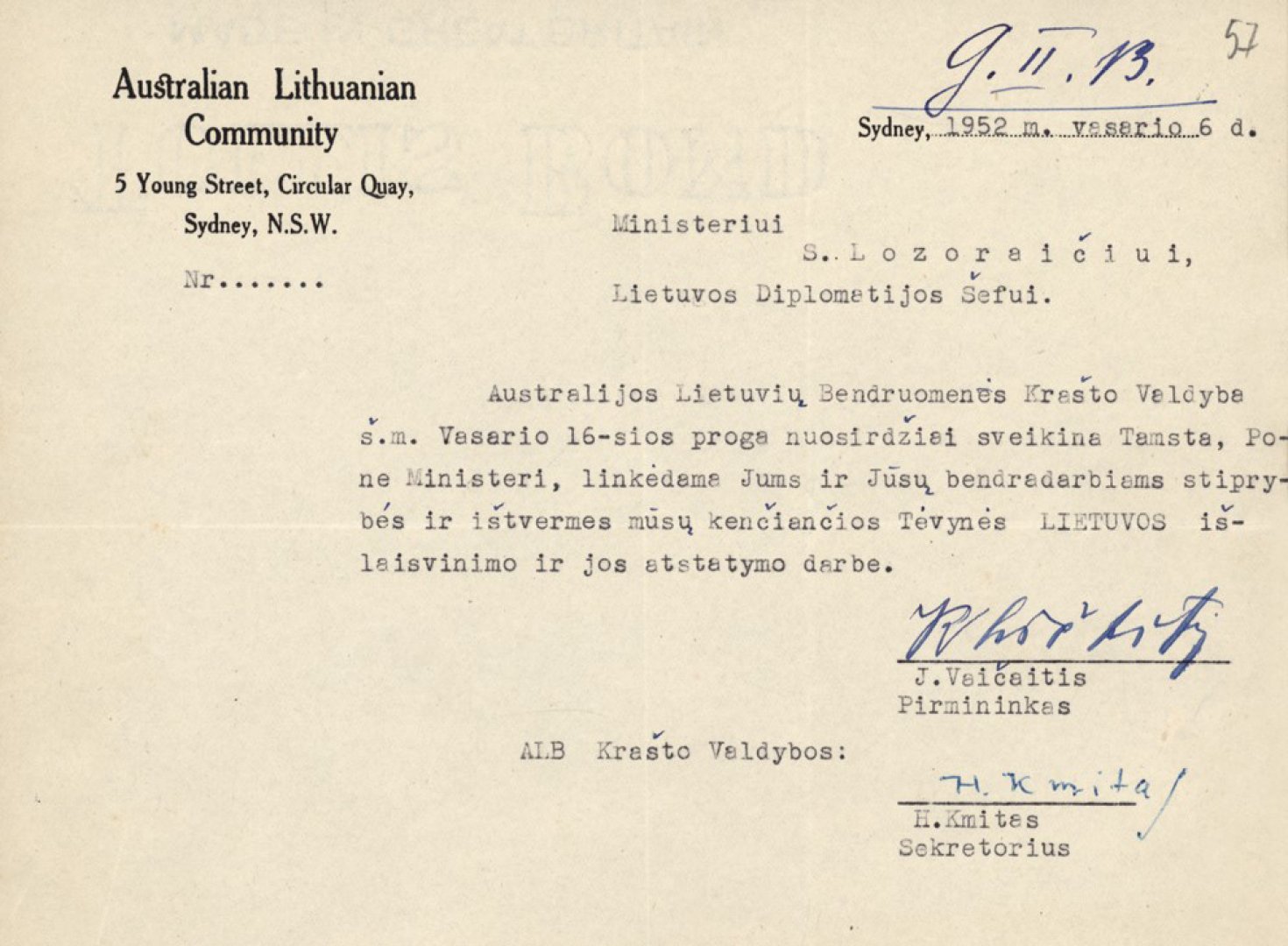
Greeting from the Australian Lithuanian Community (ALC) Country Council to the Head of Lithuanian Diplomacy, Stasys Lozoraitis, on the occasion on February 16th

Sydney, February 6, 1952

Lithuanian Central State Archives, archive No. 668, summary No. 1, file No. 396, page 57
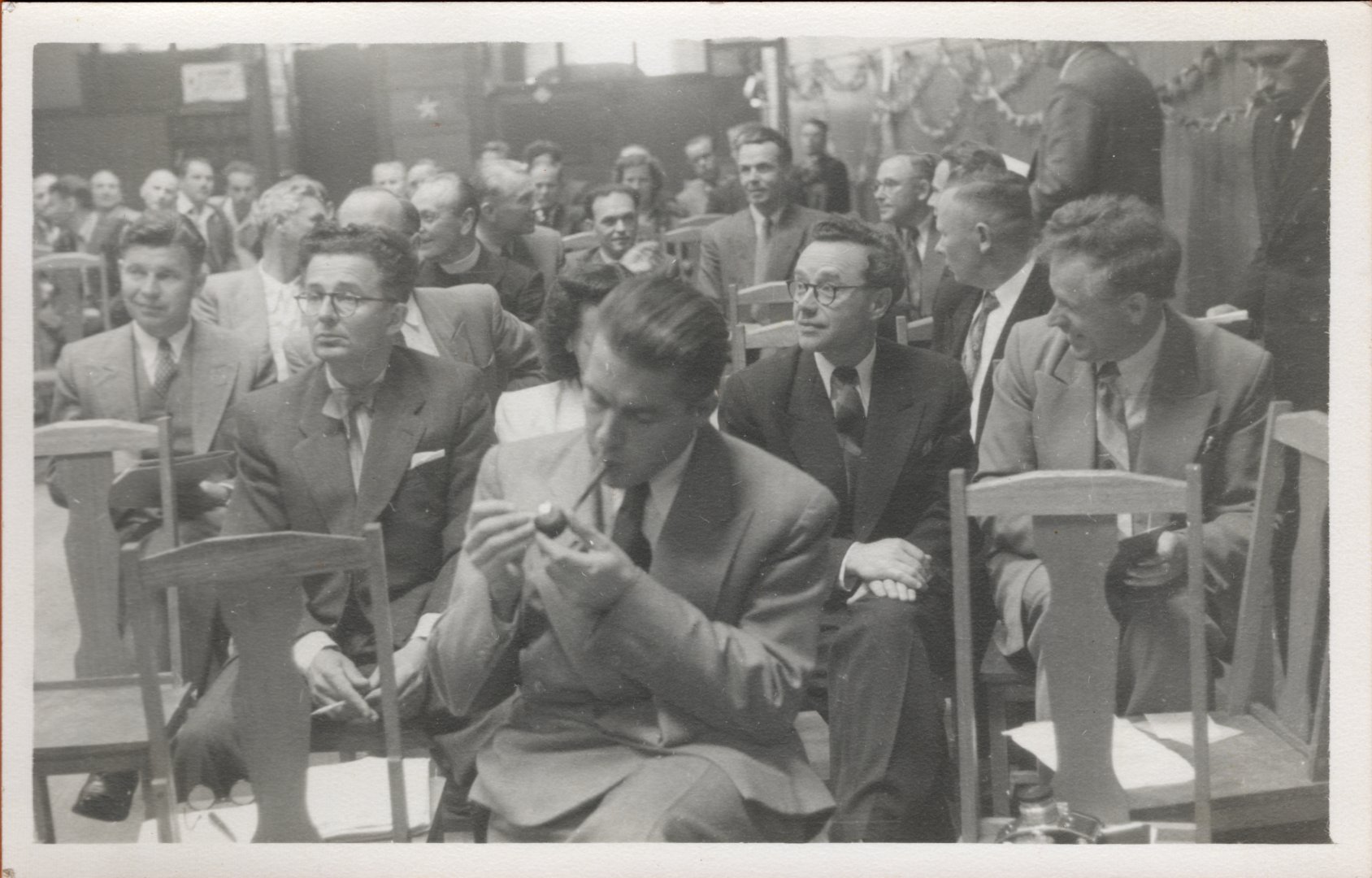
AUSTRALIAN LITHUANIANS. PART 2

Lithuanians of Geelong

Around 1951

Australian Lithuanian Archives, photo album „Lithuanians in Australia“

AUSTRALIAN LITHUANIANS. PART 2

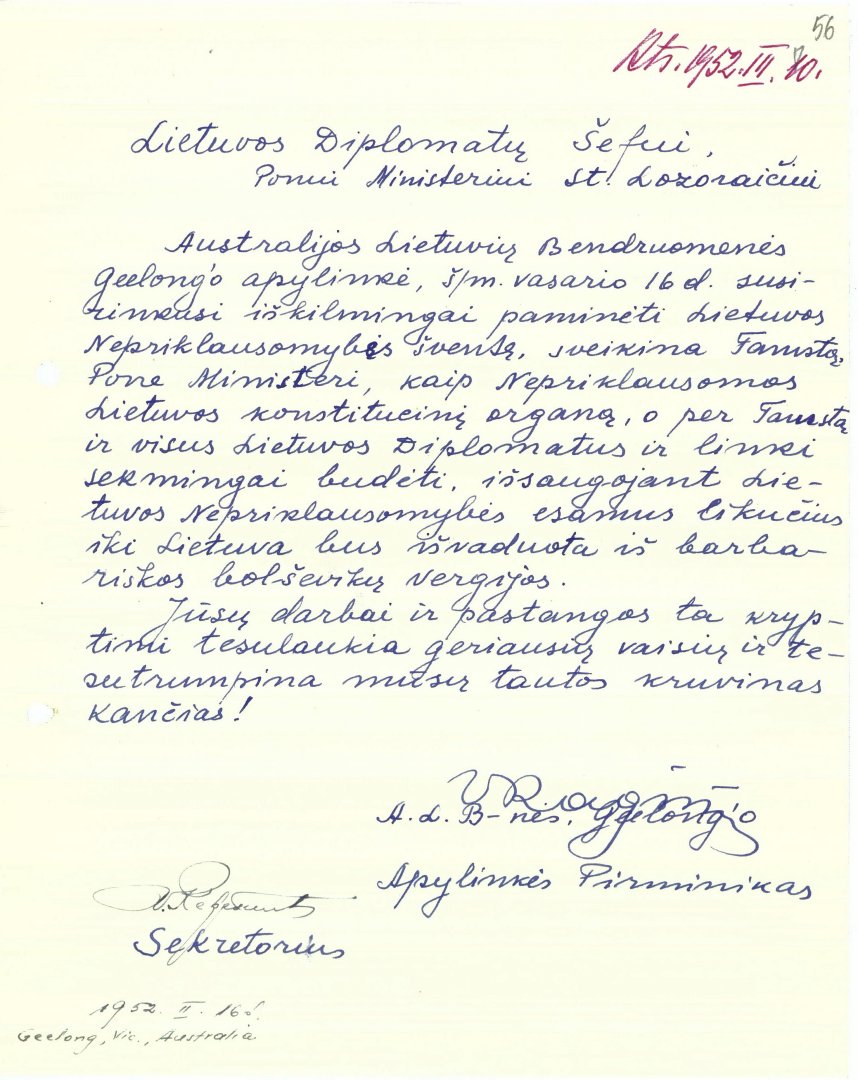
Greetings from Vaclovas Raginis, Chairman of the Lithuanian Community of Geelong, to the Head of Lithuanian Diplomacy Stasys Lozoraitis on the Occasion of February 16th

Geelong, February 16, 1952

On September 8, 1950, the Australian Lithuanian Society's Geelong branch became the Geelong district of the Australian Lithuanian Community (ALC). In 1952, the district was led by Vaclovas Raginis.

Vaclovas Raginis emigrated to Australia in 1950 and settled in Geelong, where he purchased two plots of land for a “Lithuanian House”. He was also elected to the first ALC National Council. In 1954, he moved from Geelong to Adelaide, where, thanks to his boundless energy, he revitalised the activities of the Adelaide Lithuanian Society and helped secure a “Lithuanian House”.

Lithuanian Central State Archives, archive No. 668, summary No. 1, file No. 396, page 56
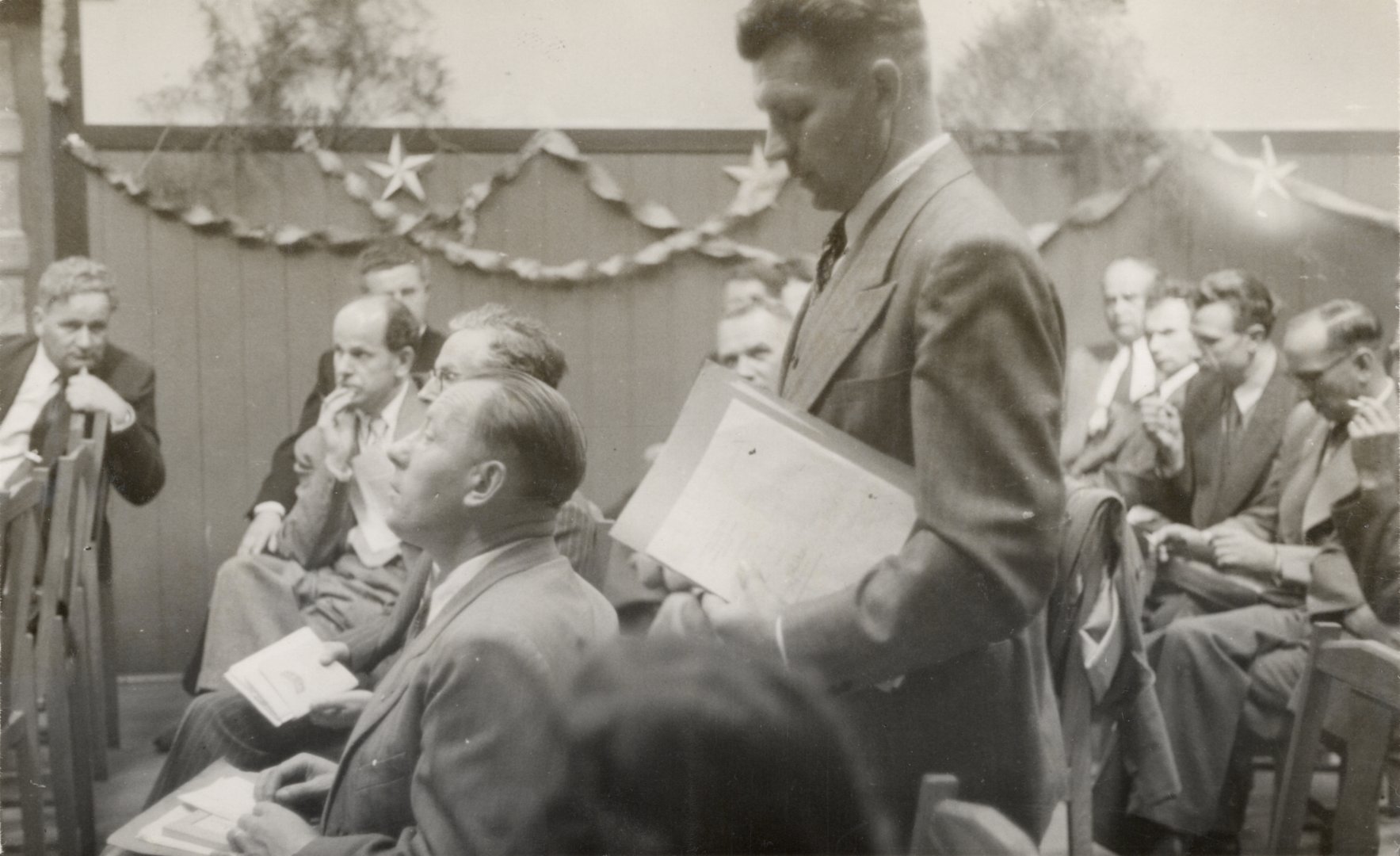
Australian Lithuanian Archives

AUSTRALIAN LITHUANIANS. PART 2

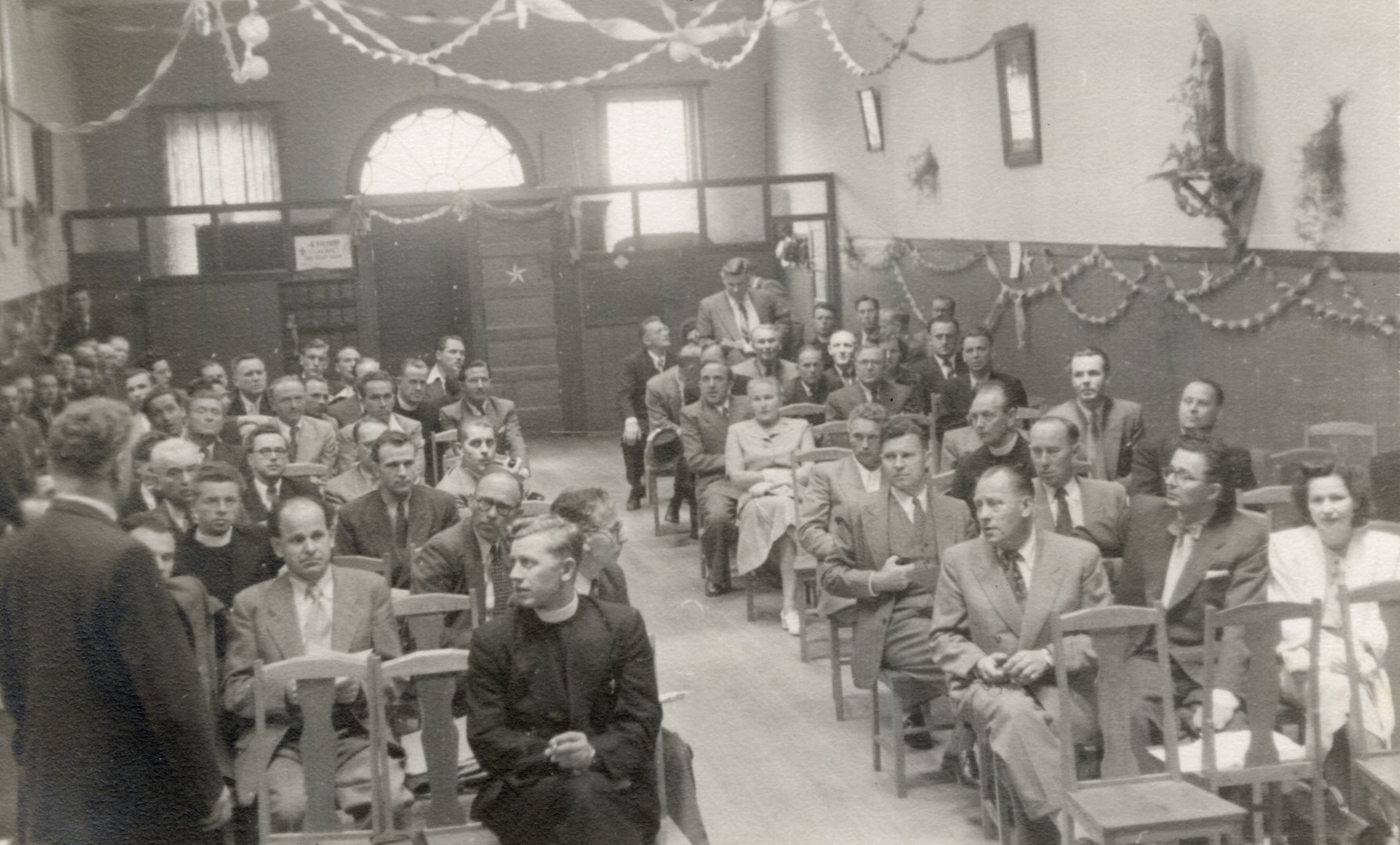
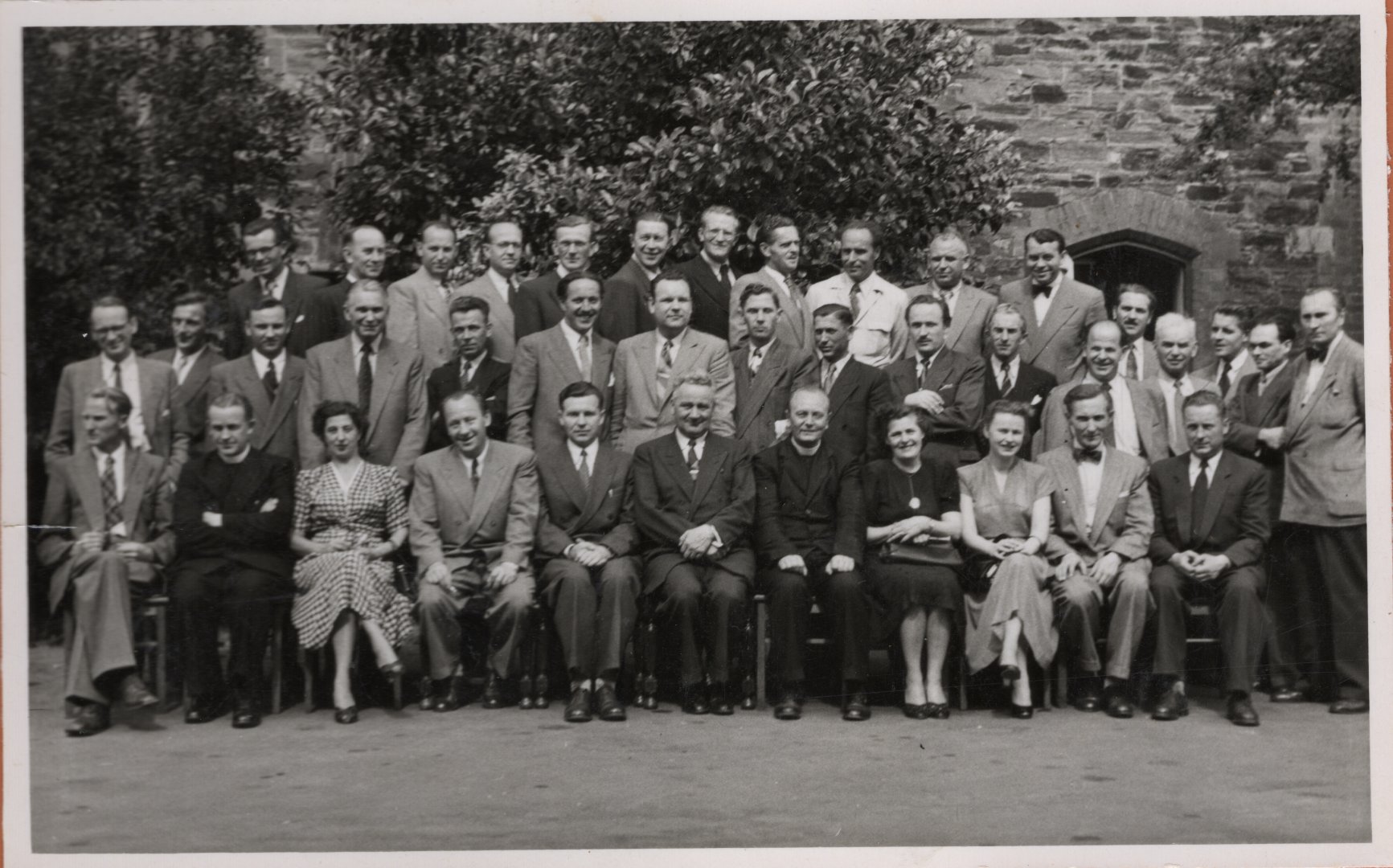
Participants of the Australian Lithuanian Community (ALC) National Council Convention in Adelaide

1952

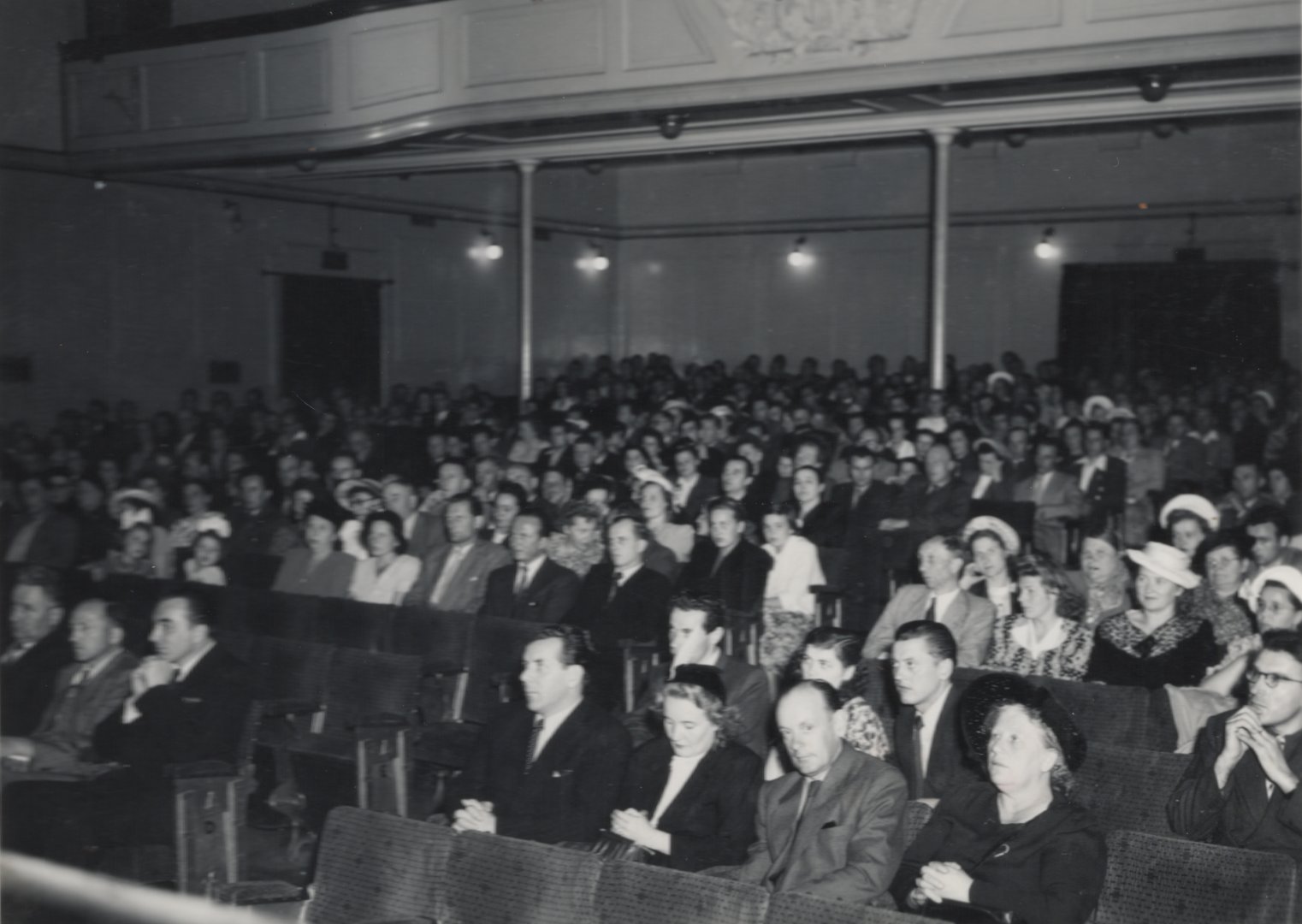
The third session of the Australian Lithuanian Community (ALC) National Council was held in Adelaide from December 28–30, 1952, in the hall of St. Xavier’s Cathedral. After the session was opened by the chair of the ALB National Council, Justinas Vaicaitis, a presidium was elected, with Justinas Kalvaitis presiding.

At this National Council convention, a lot of attention was given to issues concerning the youth and education of the community. During the session, the Adelaide district board organized a performance by the Adelaide Lithuanian Theatre, hosted an exhibition by member Antanas Rukstele, and arranged a Lithuanian press exhibition. These cultural events laid the groundwork for the Lithuanian Days, which later became a traditional event.

The activation of cultural activities during the session best represented the idea and purpose of the National Council representatives' convention.

The elected National Council decided to expand the ALC districts, weekend schools, and Lithuanian language courses, focus on anti-communist activities, and pay special attention to the creation of Lithuanian families.

Australian Lithuanian Archives, photo album „Lithuanians in Australia“

AUSTRALIAN LITHUANIANS. PART 2

Lithuanians of Sydney at the 700th Anniversary of the Baptism of Lithuania Celebration

Sydney, 1951

Australian Lithuanian Archives, photo album „Lithuanians in Australia“

AUSTRALIAN LITHUANIANS. PART 2

Chairman of the Sydney District of the Australian Lithuanian Community (ALC) Stasys Pacesa

Sydney, November 16, 1952

The Australian Lithuanian Community (ALC) Sydney District developed from the long-standing Australian Lithuanian Society that had been operating in Sydney for many years. On December 30, 1948, during a general meeting of the Australian Lithuanian Society held in Sydney, a decision was made to unite all Lithuanians in Australia. Lithuanians living in Sydney were instructed to reorganize into the Sydney branch of the ALS (Australian Lithuanian Society).

A meeting of the ALS Sydney branch was convened on February 6, 1949. On August 13, 1950, the ALS Sydney branch held a meeting to honor the President of Lithuania, Kazys Grinius, and to discuss reorganization. The resolutions passed at the meeting concluded the activities of the ALS Sydney branch and initiated the work of the ALC Sydney District.

The Sydney District Board took on the task of leading the Lithuanian community's public activities, including supporting the February 16 Gymnasium and Sydney Saturday Schools, publishing the newspaper "Mūsų pastogė," organizing the celebrations for February 16th, the Army Day, Mother's Day, commemoration of the tragic June events, sports festivals, and the Congress of the Council of the Country.

The primary goal of their activities was the acquisition of “Lithuanian homes”.

Australian Lithuanian Archives, photo album „Lithuanians in Australia“

AUSTRALIAN LITHUANIANS. PART 2

Lithuanians of Sydney

Sydney, November 16, 1952

Until 1970, Sydney was the center of the Lithuanian community in Australia. The headquarters of the Australian Lithuanian Community (ALC), the newspaper “Mūsų pastogė”, the National Fund representative office, and other organizations were based there.

During the 12th session, the members of the Australian Lithuanian Community (ALC) Country Council approved the corresponding amendments to the ALC statute, which resulted in the relocation of the Country Board to Adelaide. The 15th ALC Country Council session ultimately finalized changes to the ALC statute. The ALC Country Board's headquarters were subsequently established in Adelaide, Melbourne, and Sydney in turn.

Australian Lithuanian Archives, photo album „Lithuanians in Australia“

AUSTRALIAN LITHUANIANS. PART 2

Chairman of the Australian Lithuanian Community (ALC) Country Board Justas Vaicaitis greets the New Year

In the middle – Juozas Lapsys, Chairman of the Adelaide District Board.

Adelaide, 1953

In the middle – Juozas Lapsys, Chairman of the Adelaide District Board.

AUSTRALIAN LITHUANIANS. PART 2

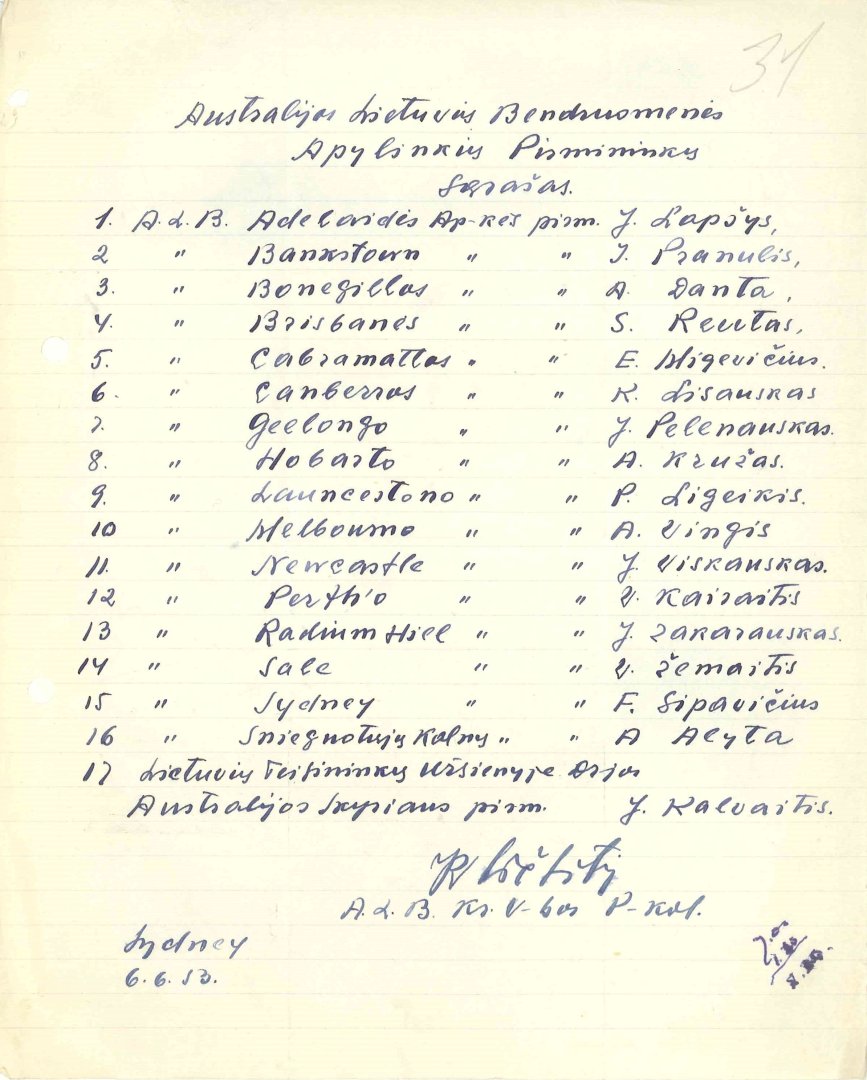
List of the Chairmen of the Australian Lithuanian Community (ALC) Districts

Sydney, June 6, 1953

Lithuanian Central State Archives, archive No. 648, summary No. 2, file No. 366, page 31

AUSTRALIAN LITHUANIANS. PART 2

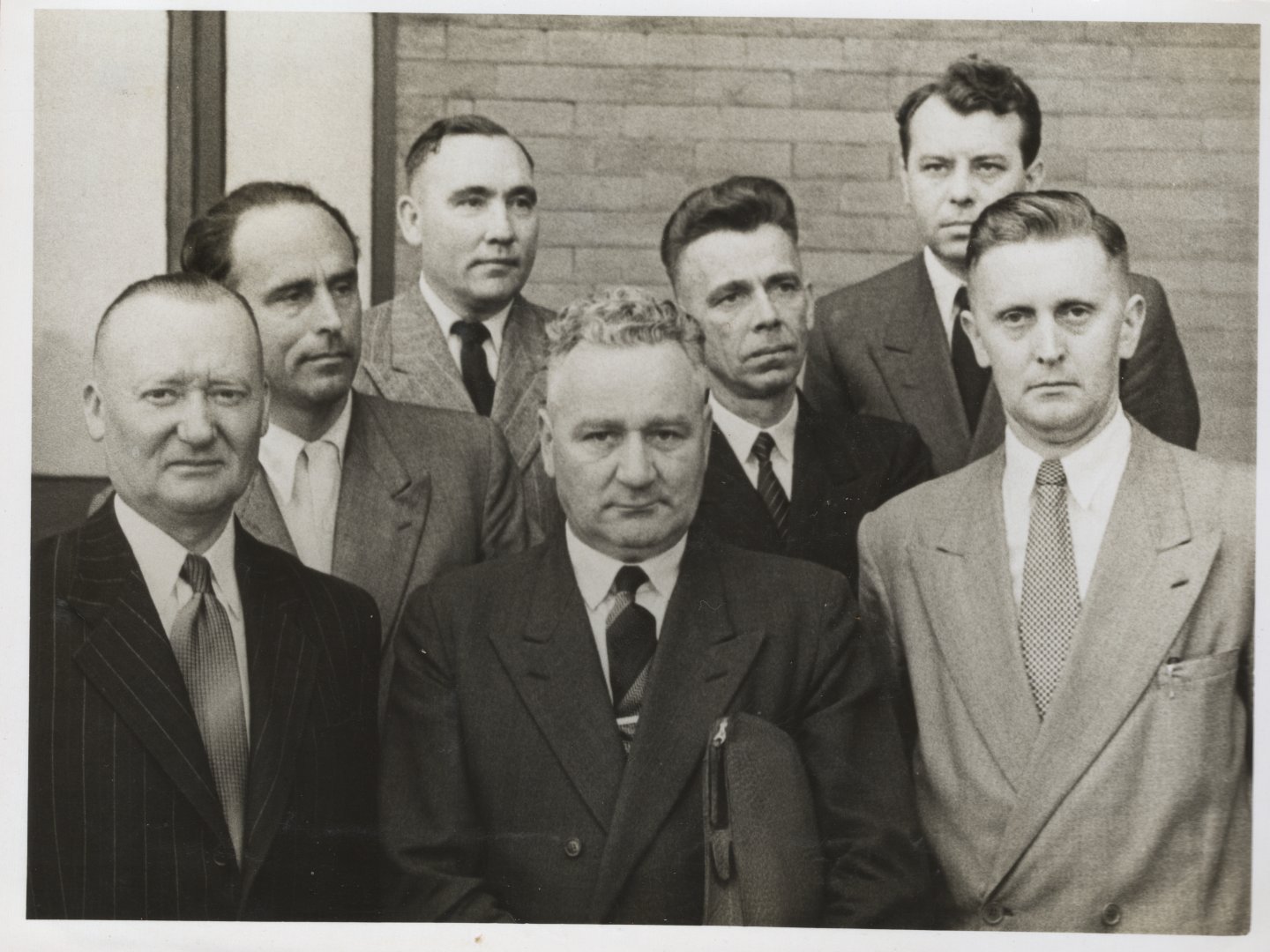
Australian Lithuanian Community (ALC) National Board

Back from left: Jurgis Bistrickas, Henrikas Kmitas, Simas Grina, Vytautas Simniskis.

Front: Leonardas Karvelis, Justinas Vaicaitis, Boleslovas Barkauskas.

[1953]

Australian Lithuanian Archives, photo album „Lithuanians in Australia“

AUSTRALIAN LITHUANIANS. PART 2

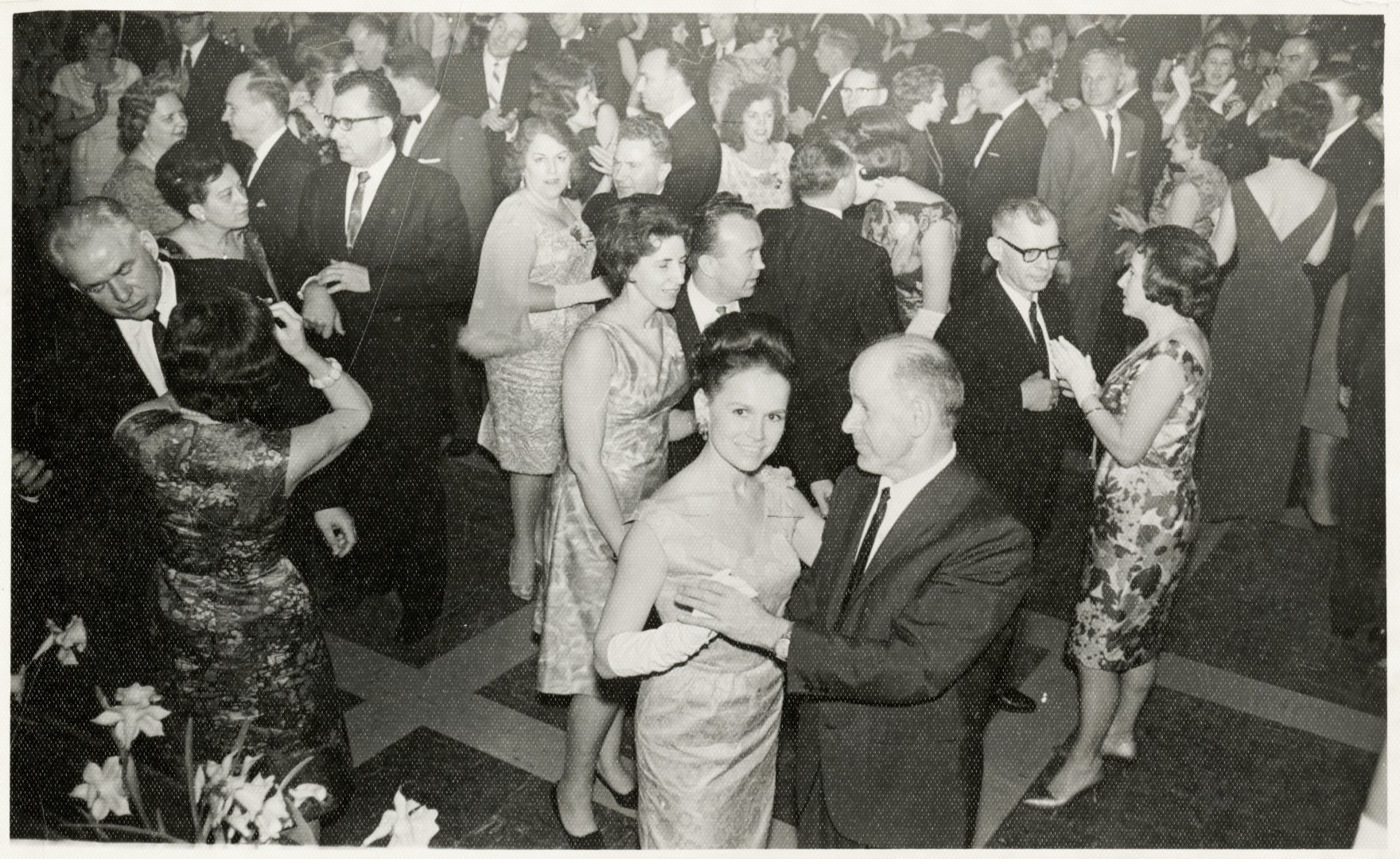
Celebration of the Australian Lithuanian Community (ALC), with S. Balciunas dancing in the front

Around 1955

Lithuanian Central State Archives, P-58225

AUSTRALIAN LITHUANIANS. PART 2

Representatives from Adelaide to the Australian Lithuanian Community (ALC) Council Convention

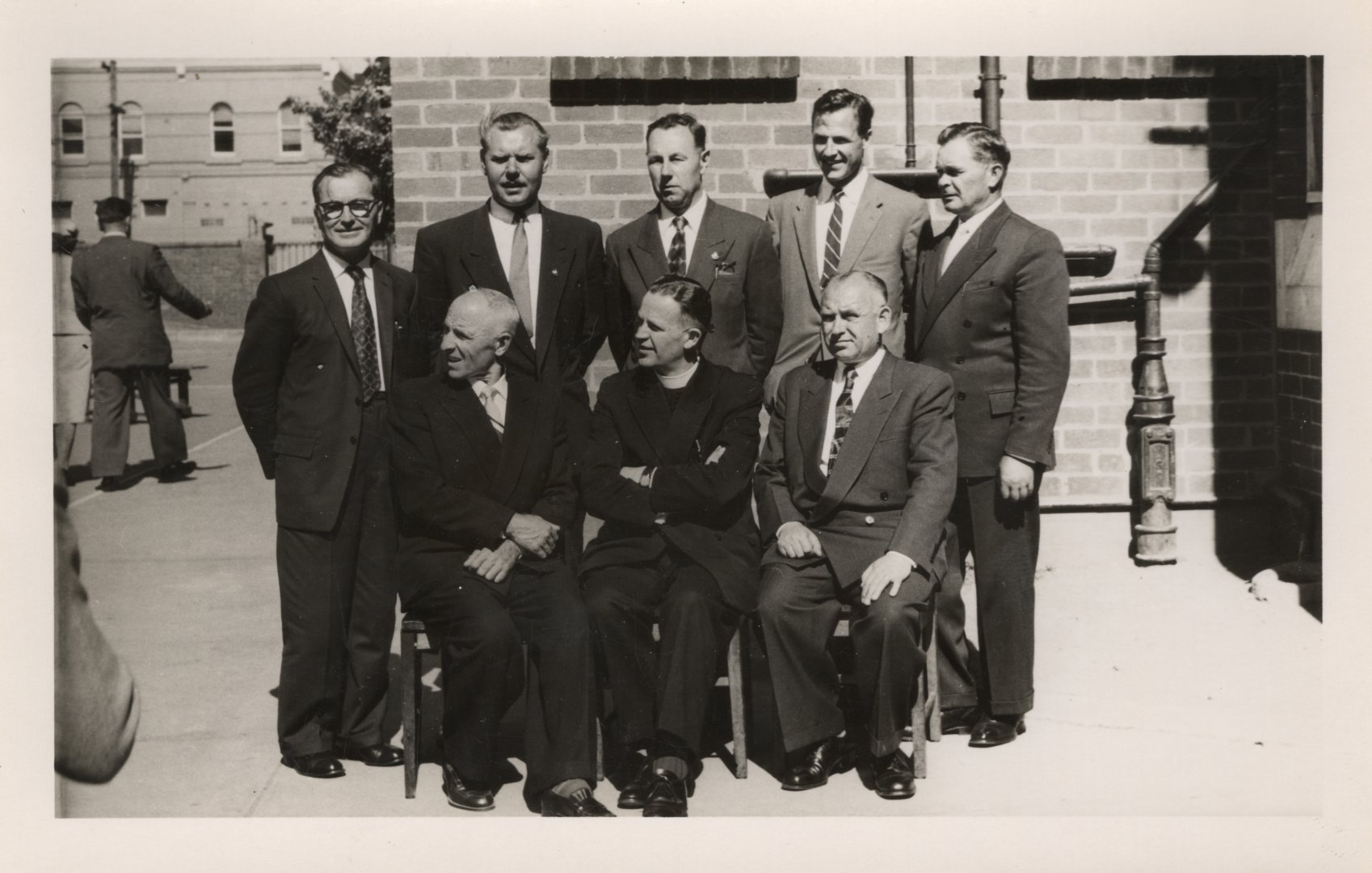
In the front row, sitting: Balys Diciunas, Father Juozas Kungys, Vaclovas Raginis. In the second row, standing: Aleksandras Morkunas, Aleksandras Sliuzas, Antanas Mikeliunas, Stasys Cibiras, Ceslovas Ostrauskas.

Adelaide, December 28, 1958

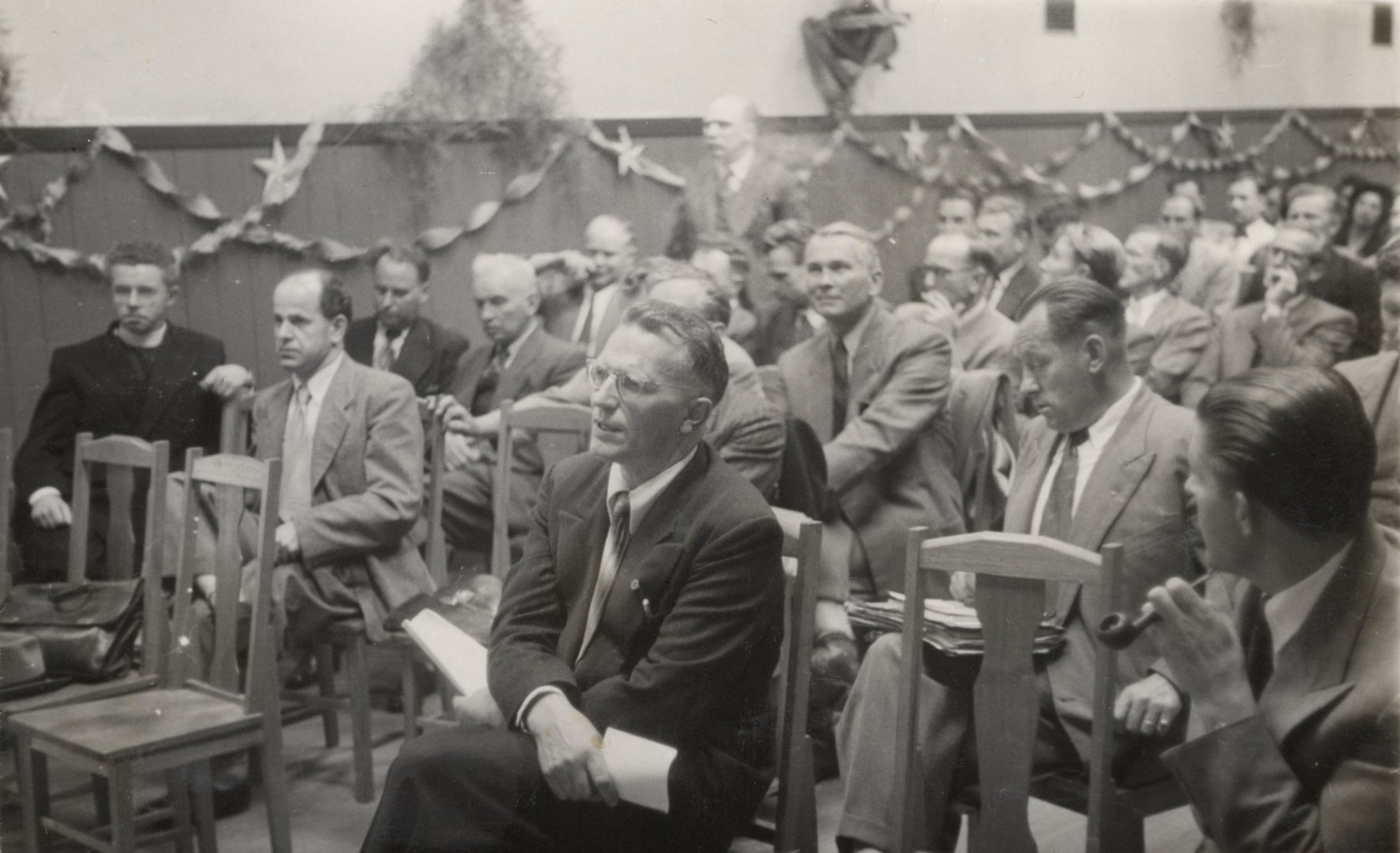
The Australian Lithuanian Community (ALC) Council's 6th session took place from December 28-30, 1958, in Melbourne. Serious and lively discussions arose over the review and final approval of the ALB statute. The statute was debated, revised, and adopted section by section. The members of the Australian Lithuanian Community were obligated by the statute to pay what is known as the "Australian Lithuanian fee." The Council's convention adopted several resolutions on the organizational and cultural life of the Australian Lithuanians and sent a protest telegram to the Vatican regarding the reduction of the rights of the Lithuanian Legation to the Holy See.

The Australian Lithuanian Community (ALC) Council is elected every two years by secret ballot. Before the ordinary session of the Council, each local branch board proposes candidates for the future Council at its annual meeting.

The elected Council members attend the convention, which is usually held during the Australian Lithuanian Days, and during the session, they conduct elections for a new Council.

The newly elected Council is required to serve for two years, until the next Council session. In addition to the Council, the session also elects the Council's Control Commission and the Council's Honorary Tribunal.

Australian Lithuanian Archives, document No. PH0165

AUSTRALIAN LITHUANIANS. PART 2

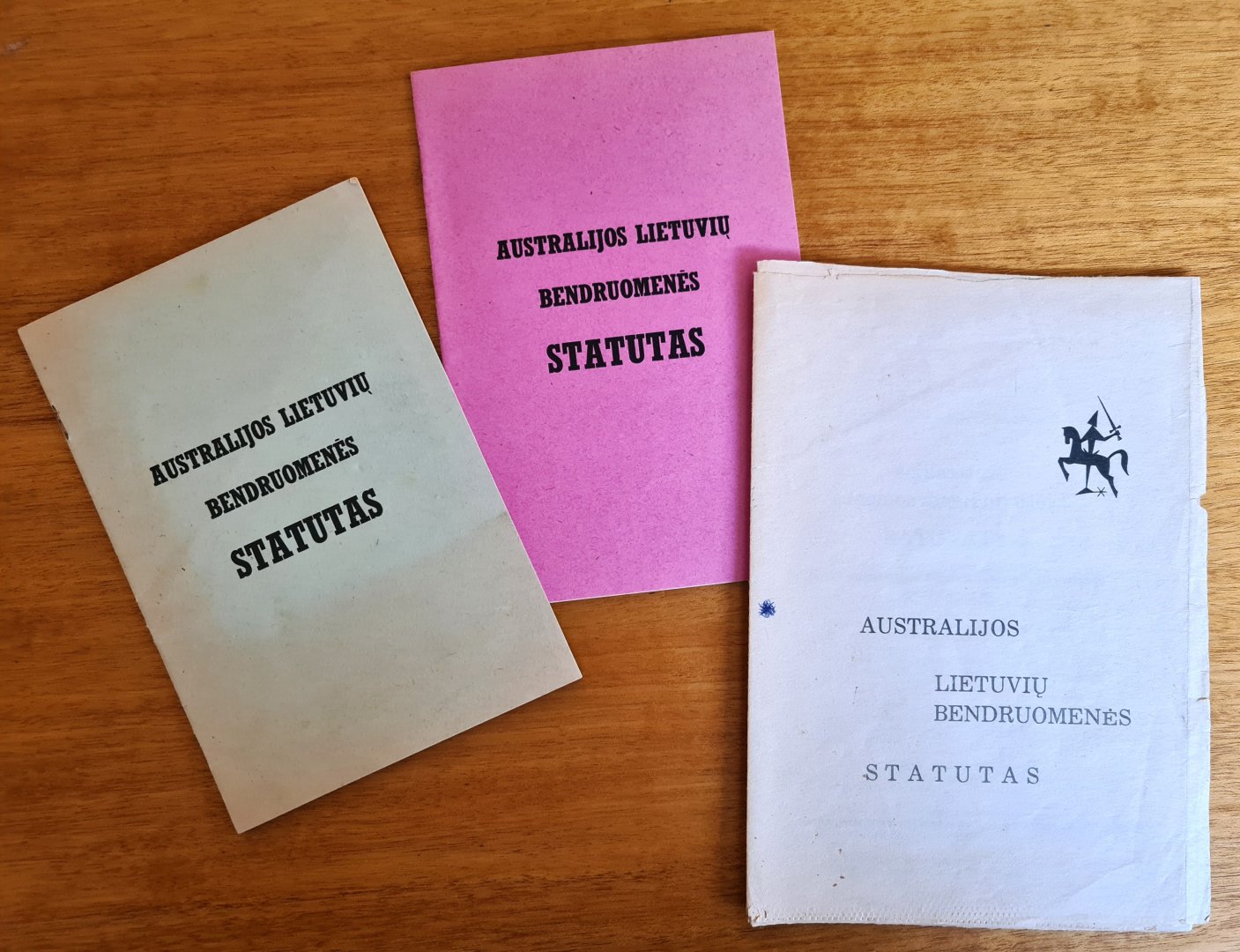
Statutes of the Australian Lithuanian Community (ALC)

June 19, 1959, and February 7, 1977

Photographed in November 2023 at the Australian Lithuanian Archives. Photo by Dziuginta Abromaitiene.

Lt En